
Upcoming IPCEI Funding Opportunities in Europe
Important Projects of Common European Interest, or IPCEIs, are among Europe’s most strategic funding routes for large-scale innovation, first industrial deployment and cross-border industrial collaboration.
A new wave of IPCEI activity is emerging across artificial intelligence, compute infrastructure and circular advanced materials. For companies developing technologies that are too strategic, risky or capital-intensive to be financed by the market alone, IPCEIs can offer a pathway to significant public support through Member State-led State aid processes.
Impact Funding Europe helps companies assess whether their projects fit upcoming IPCEI opportunities, prepare for expressions of interest, build European partnerships and develop the evidence needed for national and European assessment.
Latest IPCEI Tracking Note
May 2026 update: Impact Funding Europe is tracking national expression-of-interest, matchmaking and project formation activity across IPCEI AI, IPCEI CIC and IPCEI CAM. Timelines vary by Member State, and companies should verify the relevant national window before preparing an application.
The 2026 IPCEI Wave: AI, CIC and CAM
Europe is using IPCEIs to support strategic technologies that are essential for competitiveness, industrial resilience, digital sovereignty and climate neutrality. Three IPCEI opportunities are especially relevant in 2026.
IPCEI AI · Artificial Intelligence
Current position: Expression-of-interest and matchmaking activity across participating Member States.
Best-fit companies: AI developers, industrial AI platforms, data infrastructure companies, robotics, autonomous systems, logistics, mobility and manufacturing AI companies.
IPCEI CIC · Compute Infrastructure Continuum
Current position: Project formation and national expression-of-interest activity linked to Europe’s sovereign cloud-edge infrastructure agenda.
Best-fit companies: Cloud providers, edge computing companies, data centre operators, AI infrastructure providers, telecoms and cybersecurity companies.
IPCEI CAM · Circular and Advanced Materials
Current position: Candidate IPCEI with first national expressions of interest launched in 2026.
Best-fit companies: Advanced materials companies, recyclers, clean technology manufacturers, battery, mobility, energy and electronics value-chain actors.
Assess IPCEI CAM readiness for circular advanced materials projects
These opportunities are different, but they are connected. IPCEI CIC focuses on the infrastructure layer: cloud, edge and distributed compute. IPCEI AI focuses on the intelligence layer: sovereign AI technologies and industrial applications. IPCEI CAM focuses on the materials layer: circular and advanced materials for clean technology value chains.
Together, they reflect Europe’s broader push for strategic autonomy in the technologies that will shape the next decade.
What is an IPCEI?
An IPCEI is a cross-border State aid framework designed to support large-scale innovation, infrastructure and first industrial deployment that market forces alone cannot finance.
IPCEI stands for Important Project of Common European Interest. IPCEIs allow EU Member States to support projects of major strategic importance where the market alone would not deliver the required investment, scale or speed.
IPCEIs are not ordinary EU grant calls. They are Member State-led State aid processes. This means that funding is usually provided by national authorities, while the European Commission, particularly DG COMP, the Directorate-General for Competition, assesses whether the proposed aid is compatible with EU State aid rules.
The purpose of an IPCEI is to make it possible for Member States to support projects that create value beyond one company, one sector or one country. An IPCEI should bring together knowledge, expertise, financial resources and economic actors across Europe to address market failures, systemic failures or major societal challenges that cannot be solved sufficiently by the market alone.
In practical terms, IPCEIs are designed for projects that are:
- strategically important for Europe;
- highly innovative or infrastructure-critical;
- cross-border in scope;
- too risky, complex or capital-intensive to proceed without public support;
- capable of generating positive spillovers beyond the direct beneficiaries;
- aligned with EU priorities such as the green transition, digital transition, industrial competitiveness, resilience and strategic autonomy.
Official sources on the IPCEI framework
IPCEI is Not the Right Route for Every Project
One of the most important lessons from previous IPCEIs is that the instrument is selective. IPCEIs can unlock significant public support, but only where a project genuinely fits the logic of the framework.
A standard company expansion, incremental product upgrade or routine commercial investment will usually not be enough. IPCEI projects need to show why they are exceptional.
A strong project normally needs to answer five questions clearly. These questions are also useful for companies preparing their market failure rationale under the IPCEI and RDI framework:
- Why is the project important for Europe?
- Why is the project beyond the state of the art?
- Why is public support necessary?
- Why does the project need cross-border collaboration?
- What wider benefits will the project create?
If these questions cannot be answered convincingly, other funding routes such as Horizon Europe, the Innovation Fund, Digital Europe, national innovation schemes, regional funding or blended finance may be more suitable.
How IPCEI Funding Works
IPCEI funding is based on the principle that public support should be limited to what is necessary for the project to happen.
This is why the funding gap is central. The funding gap is the difference between the project’s expected costs and revenues under normal market conditions, taking account of the return a market investor would require to take the risk.
In simple terms, an IPCEI applicant must show that:
- the project would not happen without aid; or
- the project would happen later, at smaller scale, outside Europe or with lower ambition; and
- the requested support does not exceed what is necessary to make the project viable.
For companies, this means the application is not only a technical proposal. It is also a detailed economic and financial case. The project must be supported by credible assumptions, investment plans, cost estimates, revenue forecasts, counterfactual scenarios and funding gap calculations.
| Topic | What companies need to understand |
|---|---|
| Source of funding | IPCEI support is normally provided by Member States through State aid, not directly through a central EU grant budget. |
| Eligible logic | Aid must be necessary, proportionate and linked to a project that would not proceed in the same way under normal market conditions. |
| Funding gap | The maximum support is linked to the funding gap, not simply to a fixed grant rate. |
| Eligible activities | IPCEIs can support R&D&I, first industrial deployment and, in some cases, open infrastructure. |
| Company contribution | Beneficiaries are expected to co-finance the project and demonstrate serious investment commitment. |
| Commission review | The European Commission assesses innovation, European relevance, proportionality, spillovers and potential market distortion. |
This makes IPCEI applications different from many standard grant applications. Companies must combine a strong technology case with a robust investment case and a convincing State aid rationale.
What Types of Activities Can IPCEIs Support?
IPCEIs can support ambitious research, development and innovation activities. They can also support first industrial deployment where the project remains highly innovative and linked to prior R&D&I.
This is important for companies that are beyond early-stage research but not yet at routine commercial deployment. Potentially relevant activities include:
- breakthrough R&D and technology development;
- pilot lines and demonstration facilities;
- first-of-a-kind industrial deployment;
- scale-up of innovative production processes;
- strategic infrastructure linked to a wider European value chain;
- deployment of technology that enables cross-border industrial ecosystems;
- dissemination, standardisation, interoperability and spillover activities.
IPCEIs do not normally support mass production or routine commercial activity. They are intended for the difficult middle ground where innovation is mature enough to require large investment, but still too risky or strategically important to be financed on normal market terms.
How the IPCEI Process Usually Works
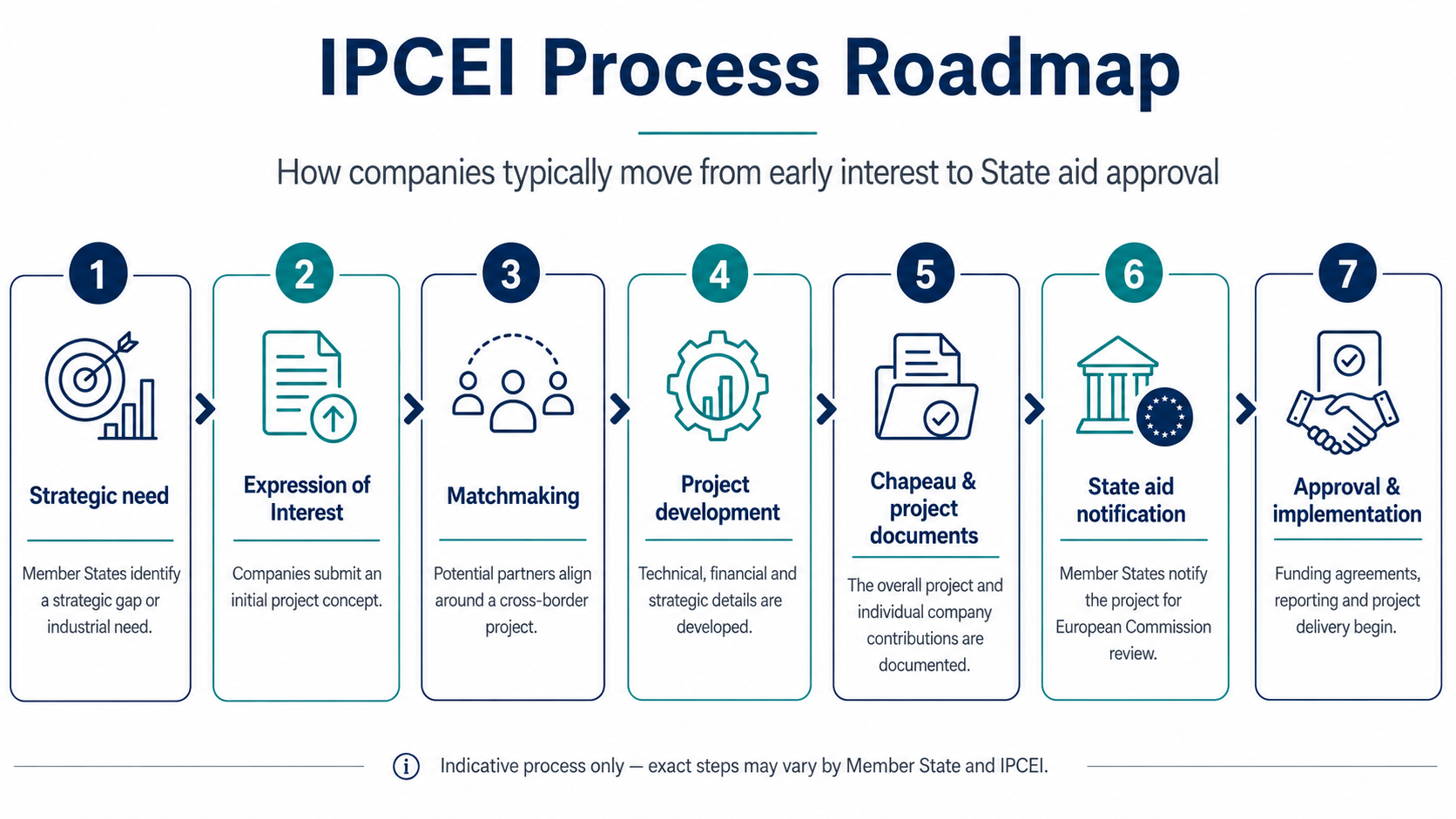
The exact process differs by Member State and IPCEI, but companies should expect a multi-stage process involving national authorities, European matchmaking and European Commission State aid review.
-
Strategic Need and Member State Interest
An IPCEI often begins when one or more Member States identify an investment gap, innovation gap or strategic dependency in a sector or value chain. Companies, industry associations and research organisations can influence this early stage by demonstrating why a sector matters for Europe.
-
National Expression of Interest
A national authority may open an expression-of-interest process to identify companies and project ideas. This is usually not a funding award. It is an early screening step used to assess whether projects could fit the IPCEI logic.
-
Matchmaking and Consortium Formation
Companies may be invited to matchmaking with potential partners from other Member States. This stage is important because individual company projects must fit into a wider European structure, roadmap or value chain.
-
Pre-Notification Preparation
After national selection and consortium formation, companies usually prepare material for the pre-notification stage. This is where the project becomes much more detailed.
-
Chapeau and Individual Project Documentation
An integrated IPCEI typically includes an overarching chapeau document explaining the common European project and individual project documents explaining each participant’s contribution.
-
Formal State Aid Notification and Commission Assessment
Member States submit the State aid notification to the European Commission. The Commission assesses whether the aid is necessary, proportionate and compatible with the internal market.
-
Compatibility Decision, Funding Agreement and Implementation
If the Commission adopts a positive compatibility decision, Member States can move to funding agreements with selected companies. The project then enters implementation, usually with reporting, milestone, dissemination and collaboration obligations.
What Makes a Project IPCEI-Ready?
A project may be IPCEI-ready if it has:
- a clear technological or industrial ambition beyond the state of the art;
- strategic relevance for Europe, not only for the applicant;
- a strong link to a European value chain;
- credible cross-border collaboration potential;
- significant investment needs;
- a demonstrable funding gap;
- strong internal commitment and co-financing capacity;
- a realistic implementation plan;
- measurable spillovers, such as knowledge sharing, standards, interoperability, supplier development, open access, licensing, training or ecosystem development.
Companies should also be prepared for the workload. An IPCEI process can require significant internal resources, senior management attention, financial modelling, technical documentation, partner coordination and interaction with national authorities.
Current IPCEI Opportunities We Are Tracking
The IPCEI pipeline is broader than one or two calls. For Impact Funding Europe’s clients, the most relevant near-term cluster is AI, compute infrastructure and circular advanced materials. We also monitor adjacent strategic areas such as advanced semiconductor technologies, innovative nuclear technologies, biotechnology, critical raw materials, carbon capture, quantum computing and low-carbon industry.
IPCEI AI · Artificial Intelligence
IPCEI AI is focused on building a sovereign European AI ecosystem for industry. It is relevant for companies developing AI infrastructure, sector-specific AI solutions, industrial AI applications, robotics, autonomous systems, AI-enabled logistics, autonomous manufacturing and other high-impact AI technologies.
Best suited for: AI developers, industrial technology companies, data platforms, robotics companies, mobility players, logistics platforms, manufacturing technology companies and companies seeking associated partner or consortium roles.
Book a Matchmaking Strategy Session Explore IPCEI AI funding and matchmaking support
IPCEI CIC · Compute Infrastructure Continuum
IPCEI CIC focuses on Europe’s next-generation compute infrastructure continuum. It is linked to cloud, edge computing, distributed data processing, sovereign infrastructure and AI-ready compute capacity.
Best suited for: Cloud providers, edge computing companies, data centre operators, AI infrastructure companies, telecoms, cybersecurity companies, orchestration platforms and software infrastructure providers.
Request an Eligibility and EoI Audit Read our guide to IPCEI CIC infrastructure eligibility
IPCEI CAM · Circular and Advanced Materials
IPCEI CAM focuses on circular and advanced materials for clean technologies. It is particularly relevant for materials and processes that support energy, mobility, electronics and broader clean technology value chains.
Best suited for: Advanced materials producers, recycling technology companies, clean technology manufacturers, battery value-chain companies, semiconductor and electronics suppliers, circular economy innovators and industrial scale-up companies.
Assess Your IPCEI CAM Readiness Assess IPCEI CAM readiness for circular advanced materials projects
How Impact Funding Europe Can Help
Impact Funding Europe supports companies throughout the IPCEI preparation process, from early opportunity assessment to application strategy.
IPCEI Fit Assessment
We assess whether your project has the scale, innovation level, strategic relevance and funding gap profile required for an IPCEI.
Opportunity and Country Mapping
We help identify which IPCEI opportunity and which national process may be relevant for your project.
Expression of Interest Support
We help prepare clear and persuasive expression-of-interest material, including the project concept, innovation narrative, European relevance and initial funding rationale.
Consortium and Matchmaking Strategy
We support partner mapping and help position your project within a wider European value chain or integrated project structure.
Funding Gap and Business Case Preparation
We help develop the financial logic needed to explain why public support is necessary and proportionate.
Chapeau and Project Documentation Support
We support the preparation of individual project documentation and input into broader IPCEI-level narratives.
Alternative Funding Route Analysis
If IPCEI is not the right fit, we help identify alternative EU, national or blended finance routes.
Why Prepare Early?
IPCEI processes often move before final details are visible. National expressions of interest may open with short deadlines, matchmaking can shape which partners are included, and companies that prepare early are better placed to define their role in the European project. Early preparation helps companies:
- clarify whether IPCEI is realistic;
- identify the right national authority and process;
- develop a stronger project concept;
- find partners before matchmaking becomes crowded;
- prepare confidential technical and financial information;
- understand the likely funding gap and co-financing requirement;
- avoid wasting time on an unsuitable funding route.
You may also want to review our European funding strategy and application support.
Speak to an IPCEI Funding Expert
If your company is developing a strategic project in artificial intelligence, compute infrastructure, cloud-edge systems, advanced materials, circularity or clean technologies, now is the time to assess whether an IPCEI route is realistic.
Impact Funding Europe can help you understand where your project fits, what evidence you need and how to prepare for the next stage.
Ready to assess your IPCEI route?
IPCEI FAQ
What does IPCEI stand for?
IPCEI stands for Important Project of Common European Interest. It is a State aid framework that allows EU Member States to support major strategic projects that contribute to European objectives.
Is IPCEI funding the same as an EU grant?
No. IPCEIs are not standard EU grant calls. They are Member State-led State aid processes. Funding is usually provided by national authorities, while the European Commission assesses whether the aid is compatible with EU State aid rules.
Who can apply for an IPCEI?
Large companies, SMEs, scale-ups, research organisations, infrastructure operators and technology providers may be able to participate, depending on the IPCEI and national process. The project must fit the scope, demonstrate European relevance and meet State aid requirements.
What is an IPCEI expression of interest?
An expression of interest is an early national screening step used to identify companies and project ideas that may fit a proposed IPCEI. Submitting an expression of interest does not guarantee funding.
What is the IPCEI funding gap?
The funding gap is the amount of support needed to make the project viable. It reflects the difference between the project’s expected costs and revenues, considering the return required by a market investor and the risks of the project.
What is a chapeau document?
A chapeau document is the overarching document that explains the common European project, its objectives, structure, participants and contribution to EU goals. Individual company projects then need to show how they fit into that wider project.
What is the difference between a direct participant and an associated partner?
A direct participant is usually part of the core IPCEI notification and may receive aid under the IPCEI framework. An associated partner may contribute to the ecosystem or value chain but may be funded through another route. Definitions can vary by IPCEI and Member State.
What projects are usually not suitable for IPCEI?
Projects based only on routine commercial expansion, incremental upgrades, standard production capacity or private benefits with limited European spillovers are usually not suitable. IPCEI projects must be exceptional, strategic and difficult to finance without public support.
How long does the IPCEI process take?
The timeline varies. Companies should expect a multi-stage process involving national expressions of interest, matchmaking, documentation, State aid notification, Commission questions and approval. Preparation should start as early as possible.
How can Impact Funding Europe help?
Impact Funding Europe helps companies assess IPCEI fit, prepare expressions of interest, build partner strategies, develop funding gap logic and identify alternative funding routes where IPCEI is not the best option.
IPCEI scopes, timelines, eligibility rules and funding routes depend on Member State participation, national budget decisions and European Commission State aid approval. This page is for general information and does not constitute legal advice or a guarantee of funding.