IPCEI CAM Funding: Circular and Advanced Materials for Clean Technology Autonomy
IPCEI CAM, the Important Project of Common European Interest on Circular and Advanced Materials, is an emerging European funding opportunity for companies developing circular, sustainable and high-performance materials for clean technologies.
The initiative is relevant for organisations working on advanced materials, recycling, sustainable sourcing, critical raw material substitution, circular design, digital material traceability, clean mobility, renewable energy, energy storage, electronics and industrial decarbonisation.
Impact Funding Europe helps companies assess whether their projects fit IPCEI CAM, prepare for national expressions of interest, build European partnerships and develop the technical, financial and State aid rationale required for the next stages.
Latest IPCEI CAM Tracking Note
May 2026 update: IPCEI CAM is in design, scoping and national expression-of-interest activity across participating Member States. Public information indicates that the initiative is focused on circular advanced materials for clean technologies, with priority areas including renewable energy and storage, industrial decarbonisation, clean mobility and applied electronics.
Timelines, eligibility rules and submission requirements vary by country. Companies should verify the relevant national window before preparing an application.
What is IPCEI CAM?
IPCEI CAM is a candidate Important Project of Common European Interest focused on circular and advanced materials for clean technologies.
The initiative is designed to support research, development, innovation and first industrial deployment projects that help Europe develop, scale and integrate circular advanced materials across strategic value chains.
For the purposes of IPCEI CAM, advanced materials are materials designed to have new or enhanced properties, targeted structural features or improved functional performance. Circular advanced materials should also contribute to circular economy strategies such as reuse, repair, remanufacturing, recycling, material efficiency, durability or reduced dependence on critical raw materials.
Unlike a standard EU grant call, IPCEI CAM is expected to operate through Member State-led State aid processes. National authorities identify potential projects through expressions of interest and selection procedures, while the European Commission assesses the compatibility of State aid with EU rules.
IPCEI CAM National Expression-of-Interest Status as of 10 May 2026
National IPCEI CAM procedures are not synchronised across Europe. Some countries have published or closed national windows, while others remain to be confirmed.
The table below is an indicative status snapshot as of 10 May 2026. Applicants should always verify the latest position with the relevant national authority.
| Country | IPCEI CAM status as of 10 May 2026 |
|---|---|
| Belgium | Open · deadline indicated: 15 June 2026 |
| Germany | Call for Expression of Interest expected |
| Netherlands | Call for Expression of Interest expected |
| Poland | Call for Expression of Interest expected |
| Slovenia | Closed · deadline indicated: 15 May 2026 |
| Austria | No IPCEI CAM window indicated in the tracker |
| Croatia | Status not yet confirmed |
| Czechia | Status not yet confirmed |
| Estonia | Status not yet confirmed |
| Finland | Status not yet confirmed |
| France | Status not yet confirmed |
| Hungary | Status not yet confirmed |
| Ireland | Status not yet confirmed |
| Italy | Status not yet confirmed |
| Lithuania | Status not yet confirmed |
| Portugal | Status not yet confirmed |
| Romania | Status not yet confirmed |
| Slovakia | Status not yet confirmed |
| Spain | Status not yet confirmed |
| Sweden | Status not yet confirmed |
Important note: “Call for Expression of Interest expected” means that publication of a national call has been indicated and remains subject to revision. “Status not yet confirmed” means that no confirmed IPCEI CAM deadline was available in the tracking snapshot. This table should be updated with official national information before publication and reviewed regularly.
Why IPCEI CAM Matters
Advanced materials are essential for Europe’s clean technology future. They are used in renewable energy systems, batteries, mobility technologies, electronics, industrial decarbonisation equipment and many other strategic sectors.
Europe faces a growing gap between the demand for advanced materials, including critical raw materials, and their availability within the European market. Circular advanced materials can help reduce dependence on externally sourced materials by keeping high-value materials and substances in the economy for longer.
IPCEI CAM is intended to strengthen Europe’s strategic autonomy, improve long-term industrial competitiveness and support the transition towards circular, low-carbon material solutions.
The opportunity is particularly relevant where projects can reduce material intensity, improve recyclability, enable repair or reuse, replace hazardous or scarce substances, increase durability, support clean technology value chains and create positive spillovers for the European materials ecosystem.
Who Should Consider IPCEI CAM?
IPCEI CAM may be relevant for:
- advanced materials producers;
- recycling and recovery technology companies;
- clean technology manufacturers;
- battery and energy storage value-chain actors;
- renewable energy component suppliers;
- clean mobility and automotive suppliers;
- electronics, semiconductor and component manufacturers;
- industrial decarbonisation technology providers;
- chemical and process industry companies;
- digital material traceability and lifecycle data companies;
- circular economy technology providers;
- research and technology organisations working with advanced materials.
The strongest candidates will usually have projects that are highly innovative, strategically relevant, difficult to finance without public support and connected to a wider European value chain.
What Types of Projects Could Fit IPCEI CAM?
Potential project areas include:
Circular advanced materials: Projects developing materials that are recyclable, reusable, repairable, remanufacturable, durable, lower-carbon or designed for longer lifetime.
Sustainable sourcing and critical raw material substitution: Projects reducing dependence on scarce, imported or strategically sensitive materials through substitution, recovery, refining, secondary raw materials or alternative feedstocks.
Circular design and Safe and Sustainable by Design: Projects integrating circularity, safety, sustainability, modularity, repairability, recyclability and lifecycle thinking from the design stage.
Digital tools for material innovation: Projects using AI, simulation, digital twins, data orchestration, material information models, Digital Product Passports, blockchain, RFID or advanced testing and validation tools.
Circular manufacturing and processing: Projects involving low-waste production, additive manufacturing, hybrid manufacturing, automated lines, resource-efficient processes and integration of secondary raw materials.
Recycling, recovery and end-of-life management: Projects improving recovery, separation, reprocessing, high-purity recycling and reintroduction of valuable materials into the economy.
Use-phase optimisation and lifetime extension: Projects enabling repair, reuse, refurbishment, second-life applications, predictive maintenance, modular upgrades and field validation.
First industrial deployment: Projects moving beyond pilot stage into first-of-a-kind industrial or field environments while remaining highly innovative and linked to prior R&D&I.
IPCEI CAM Workstreams and Value Chain Logic
The proposed IPCEI CAM structure follows the main phases of R&D&I and first industrial deployment. Projects may focus on one or more workstreams, depending on the value-chain position and the company’s specialisation.
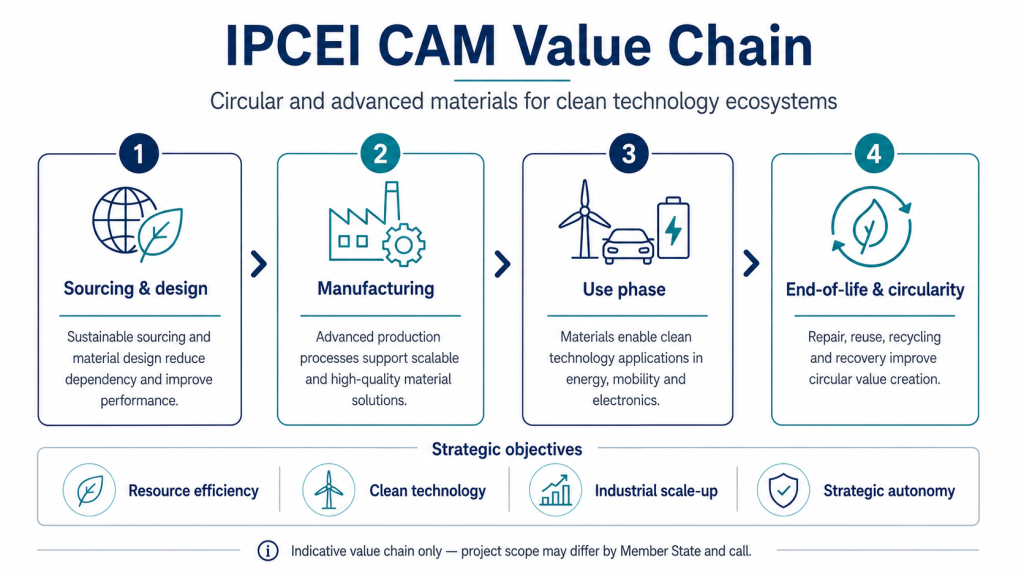
Workstream 1 · Sustainable Material Sourcing and Design of Circular Advanced Materials
This workstream covers sustainable sourcing, design, advanced material development, circular-by-design approaches, safe-and-sustainable-by-design methods, data-driven design, computational tools, predictive modelling and innovative enabling technologies for testing and validation.
Workstream 2 · Circular Manufacturing, Processing and End-of-Life Management
This workstream focuses on experimental development, manufacturability, low-waste production, advanced manufacturing, recycling, recovery, end-of-life management, supply chain resilience and transformation of legacy systems or data infrastructure where necessary for clean technology deployment.
Workstream 3 · Circularity in Application and Use-Phase Optimisation
This workstream focuses on extending the lifespan of materials and products through repair, reuse, refurbishment, second-life applications, predictive maintenance, field validation and first industrial deployment.
Applicants should clearly explain which workstream or combination of workstreams their project addresses and how the project contributes to the circular advanced materials value chain.
Circular Economy Strategies in Scope
Projects should apply at least one relevant circular economy strategy, either directly or through collaboration with partners. Relevant strategies include:
- rethink: circular design, Safe and Sustainable by Design, material traceability and new service-based models;
- reduce: lower material intensity, secondary or bio-based raw materials, lightweighting, lower energy use and cleaner processes;
- repair: easier maintenance, modular replacement and repairable product architectures;
- reuse: components and materials that can be reused across product generations or across industries;
- remanufacture or repurpose: recovery and regeneration of high-value components, coatings, composites or materials;
- recycle: advanced mechanical, chemical or bio-recycling, closed-loop systems, reverse logistics and high-purity material recovery.
Projects may also target cleaner low-waste processes, improved stability and durability, reduced hazardous substances or reduced dependence on critical raw materials.
Is Your Project IPCEI CAM-Ready?
A project may be a strong candidate for IPCEI CAM if it can answer the following questions clearly.
- Does the project involve a circular advanced material or an industrial process or application using circular advanced materials?
- Is the innovation beyond the current state of the art?
- Does the project support clean technology priority areas such as renewable energy and storage, industrial decarbonisation, clean mobility or applied electronics?
- Does the project demonstrate circularity through reuse, repair, remanufacturing, recycling, reduction, circular design or material efficiency?
- Can the company show a credible market failure or funding gap?
- Can the project demonstrate scalability, manufacturability and a pathway to market competitiveness?
- Does the project create European spillovers through knowledge sharing, standards, skills development, SME involvement, data continuity or ecosystem building?
- Is the internal team ready for the workload, including technical documentation, financial modelling, partner coordination and interaction with national authorities?
How the IPCEI CAM Process Usually Works
The exact process depends on each Member State, but companies should normally expect a structured pathway.
Scoping and National Consultation
Member States and industry stakeholders refine the scope, priority areas and structure of the candidate IPCEI.
National Expression of Interest
National authorities open a call or screening process to identify companies and project ideas.
Initial Project Assessment
Projects are assessed against scope, innovation level, circularity, European relevance, spillovers and possible State aid justification.
Matchmaking and Consortium Formation
Companies identify direct partners, associated partners and cross-border collaboration opportunities.
Full Project Proposal Development
Companies prepare technical, financial and strategic documentation, including project portfolios and funding gap logic where relevant.
Chapeau and Individual Project Documentation
The integrated IPCEI is described through an overarching chapeau document and individual project documents.
State Aid Notification and Commission Review
Member States submit the notification and the European Commission reviews necessity, proportionality, eligible costs, innovation, spillovers and competition effects.
Approval, Funding Agreement and Implementation
If approved, companies move toward implementation, reporting and delivery obligations.
Belgium Example: Open IPCEI CAM Expression of Interest
Belgium provides a useful example of how national IPCEI CAM procedures can operate. The Belgian call requires applications to be submitted to FPS Economy by 15 June 2026 at 18:00.
The Belgian process recognises both direct partners and indirect or associated partners. Direct partners may pursue R&D&I and first industrial deployment projects, while associated partners can participate in the IPCEI network through their own project and structural collaboration with at least one foreign direct partner.
This example shows why companies should not rely only on EU-level information. IPCEI CAM participation routes, documentation templates, support conditions and deadlines are defined nationally or regionally and can differ between Member States.
How Impact Funding Europe Can Help
Impact Funding Europe supports companies from early IPCEI CAM fit assessment to expression-of-interest strategy and preparation.
IPCEI CAM Readiness Assessment
We assess whether your project fits the expected scope of IPCEI CAM and whether it has the innovation level, circularity profile, strategic relevance and funding gap logic required.
Project Concept Development
We help translate materials innovation, circularity and clean technology value-chain logic into a strong funding narrative.
National Process and Opportunity Mapping
We identify which national process may be relevant and help monitor upcoming Expression-of-Interest windows, templates and submission requirements.
Partner and Matchmaking Strategy
We help define the types of European partners needed to strengthen your project and position it within a cross-border materials value chain.
Funding Gap and Business Case Support
We support the development of the financial logic needed to explain why public support is necessary and proportionate.
Chapeau and Individual Project Documentation
We support the preparation of individual project documentation and input into broader IPCEI-level narratives.
Alternative Funding Route Analysis
If IPCEI CAM is not the right fit, we help identify alternative European, national or blended finance routes.
IPCEI CAM vs Other Funding Routes
IPCEI CAM may not be the best route for every materials, recycling or clean technology project. Depending on the project scope, maturity and geography, companies may also need to consider Horizon Europe, European Innovation Council funding, the Innovation Fund, the LIFE Programme, national R&D and industrial innovation schemes, regional circular economy or clean technology funding, InvestEU and blended finance, or private equity, venture debt and project finance. Impact Funding Europe can help compare these options and identify the most realistic route for your project.
You may also want to review our European funding strategy and application support.
Speak to an IPCEI CAM Funding Expert
Companies interested in IPCEI CAM should not wait until every detail is finalised. National expressions of interest can move quickly, and companies that prepare early are better placed to define their role, identify partners and develop a credible funding case.
If your organisation is planning a major project in circular advanced materials, recycling, material substitution, clean technology materials, renewable energy, clean mobility, electronics or industrial decarbonisation, Impact Funding Europe can help you assess whether IPCEI CAM is the right route.
Official sources
Ready to assess your IPCEI CAM route?
IPCEI CAM FAQ
What does IPCEI CAM stand for?
IPCEI CAM stands for Important Project of Common European Interest on Circular and Advanced Materials.
What is the purpose of IPCEI CAM?
The purpose of IPCEI CAM is to support circular and advanced materials for clean technologies, strengthen Europe’s strategic autonomy and accelerate circular, low-carbon industrial value chains.
Is IPCEI CAM a normal EU grant call?
No. IPCEI CAM is not a standard EU grant call. It is expected to operate through Member State-led State aid processes, with national expressions of interest and European Commission State aid assessment.
Which sectors are most relevant for IPCEI CAM?
The main priority areas are renewable energy and storage systems, industrial decarbonisation and clean mobility, including applied electronics in these areas.
What types of materials projects could fit IPCEI CAM?
Projects involving circular advanced materials, sustainable sourcing, critical raw material substitution, circular design, recycling, recovery, repair, reuse, remanufacturing, digital material traceability or first industrial deployment may be relevant.
Can SMEs participate in IPCEI CAM?
Yes, SMEs may be able to participate depending on the national process and their role in the value chain. They may participate as direct partners, associated partners or linked ecosystem partners.
What should companies prepare first?
Companies should prepare a clear project concept, circularity strategy, workstream fit, innovation narrative, funding gap rationale, partner strategy and evidence of positive European spillovers.
How can Impact Funding Europe help with IPCEI CAM?
Impact Funding Europe can help assess project fit, prepare expression-of-interest material, develop the funding narrative, support funding gap logic, identify partner needs and compare IPCEI CAM with alternative funding routes.
IPCEI CAM scope, timelines, eligibility rules and funding routes depend on Member State participation, national budget decisions and European Commission State aid approval. This page is for general information and does not constitute legal advice or a guarantee of funding.