
IPCEI AI Funding and Matchmaking: Europe’s Sovereign AI Ecosystem
IPCEI AI, the Important Project of Common European Interest on Artificial Intelligence, is an emerging European funding and matchmaking opportunity for companies developing sovereign, trustworthy and industrially relevant AI technologies.
The initiative is designed to support a next-generation European AI ecosystem covering the full AI lifecycle: data provision, AI training and deployment infrastructure, open and competitive base models, inference, fine-tuning, sector-specific AI solutions and energy-efficient AI operations.
Impact Funding Europe helps companies assess whether their AI projects fit IPCEI AI, prepare for national expressions of interest, position themselves for European matchmaking and develop the technical, financial and State aid rationale required for the next stages.
What is IPCEI AI?
IPCEI AI is a planned Important Project of Common European Interest focused on building a sovereign European AI ecosystem for industry.
The goal is not only to fund individual AI tools. IPCEI AI is intended to identify complementary project ideas across participating Member States and consolidate them into a single integrated European project for assessment under EU State aid rules.
IPCEI AI is closely linked to Europe’s wider digital sovereignty agenda. It responds to the need for secure access to data, scalable computing capacity, trustworthy AI models and industrial AI applications that can be deployed across sectors and borders.
Unlike a standard EU grant call, IPCEI AI is expected to operate through Member State-led State aid processes. National authorities launch expressions of interest, identify potential projects and participate in European matchmaking before the project is consolidated for European Commission assessment.
Latest IPCEI AI Tracking Note
May 2026 update: IPCEI AI is in an expression-of-interest and matchmaking phase across participating Member States. Several national EoI windows have already closed, while a small number of countries are still expected to publish calls.
Companies should verify their relevant national process before preparing an application. Timelines, eligibility rules and submission requirements vary by country.
IPCEI AI National EoI Status as of 10 May 2026
National IPCEI AI procedures are not synchronised across Europe. This should be treated as an indicative tracking snapshot only. Applicants should always verify the latest status with the relevant national authority.
| Country | IPCEI AI status as of 10 May 2026 |
|---|---|
| Belgium | Closed · 16 January 2026 |
| Croatia | Closed · 13 February 2026 |
| Estonia | Closed · 4 March 2026 |
| Finland | Call for Expression of Interest expected |
| France | Closed · 30 January 2026 |
| Germany | Closed · 21 January 2026 |
| Hungary | Closed · 5 December 2025 |
| Ireland | Closed · 4 February 2026 |
| Italy | Closed · 30 January 2026 |
| Lithuania | Call for Expression of Interest expected |
| Netherlands | Closed · 24 March 2026 |
| Poland | Closed · 12 March 2026 |
| Romania | Closed · 9 April 2026 |
| Slovakia | Closed · 10 March 2026 |
| Slovenia | Closed · 15 December 2025 |
| Spain | Closed · 26 December 2025 |
| Sweden | Closed · 23 February 2026 |
| Austria | No IPCEI AI window indicated in the tracker |
| Czechia | No IPCEI AI window indicated in the tracker |
| Portugal | No IPCEI AI window indicated in the tracker |
Important note: “Call for Expression of Interest expected” means that publication of a national call has been indicated by the Member State and remains subject to revision. It does not guarantee that a call is open or that a company is eligible.
Why IPCEI AI Matters
Artificial intelligence is becoming a strategic industrial technology. European companies increasingly need secure access to high-quality data, scalable compute capacity, trustworthy AI models, advanced inference and fine-tuning techniques, and sector-specific AI solutions.
At the same time, many European actors still depend on non-European infrastructure, platforms, foundation models or AI services. This creates strategic concerns around data sovereignty, industrial competitiveness, security, compliance, resilience and long-term technological dependency.
IPCEI AI is designed to support a European AI continuum that can serve industrial needs. It focuses on AI that is trusted, scalable, energy-efficient, interoperable and aligned with European values and regulatory expectations.
The opportunity is particularly relevant for companies developing AI for industrial applications such as autonomous manufacturing, AI-driven logistics, autonomous driving, robotics, materials research, industrial process optimisation, smart infrastructure and the Industrial Metaverse.
Who Should Consider IPCEI AI?
IPCEI AI may be relevant for companies and organisations active in:
- industrial AI systems;
- AI model development and fine-tuning;
- high-quality data platforms and data spaces;
- AI training, deployment and operations infrastructure;
- robotics and autonomous systems;
- autonomous manufacturing and industrial automation;
- AI-driven logistics and supply-chain optimisation;
- autonomous driving and advanced mobility systems;
- simulation, digital twins and Industrial Metaverse applications;
- AI for materials research and product development;
- open-source AI platforms and shared AI tooling;
- energy-efficient AI and sustainable AI operations;
- trustworthy AI, compliance, monitoring, governance and model lifecycle management.
The best-fit applicants will usually have projects that are highly innovative, strategically relevant, technically ambitious and capable of generating spillover benefits beyond the applicant.
What Types of Projects Could Fit IPCEI AI?
IPCEI AI is likely to be most relevant for projects that contribute to the full AI lifecycle and to a sovereign European AI ecosystem. Potential project areas include the following.
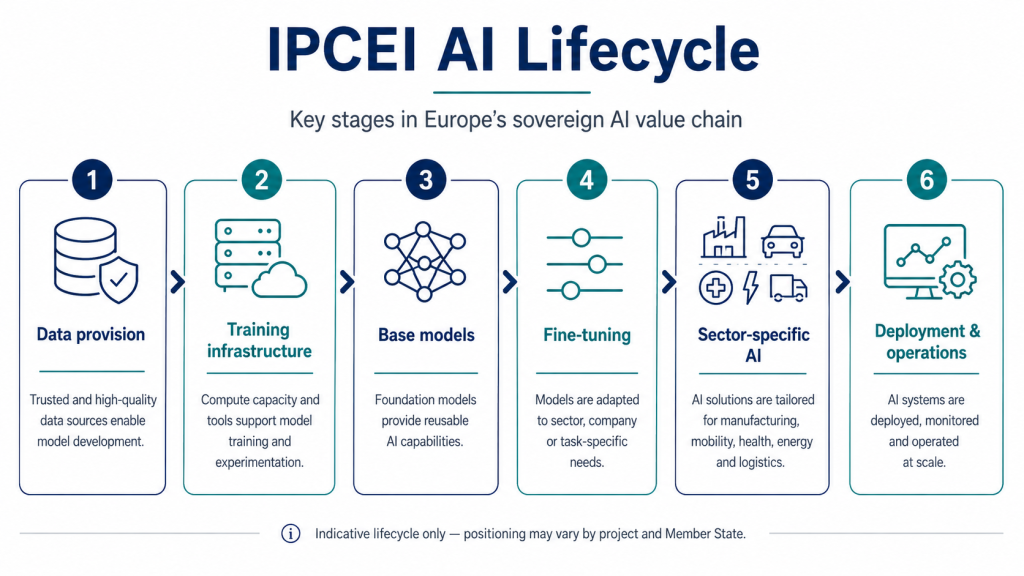
Data Provision and High-Quality Data Infrastructure
Projects that enable the collection, management, storage, labelling, governance or sharing of high-quality data for AI development. These projects should show how data availability, data quality, interoperability and European data protection requirements are addressed.
Open and Competitive Base Models
Projects developing large, sovereign, open or competitive base models for complex tasks such as language understanding, multimodal processing, simulation, industrial reasoning or domain-specific AI applications.
Sector-Specific AI Models
Projects developing AI models based on structured industry data, machine data or sector-specific datasets. Relevant sectors may include manufacturing, mobility, logistics, energy, materials, health, public services and smart infrastructure.
AI Training, Inference and Fine-Tuning Technologies
Projects that improve the training, adaptation, inference, fine-tuning, retraining, monitoring or optimisation of AI models across their lifecycle.
AI Platforms and Open-Source Tooling
Projects creating open, extensible platforms that allow developers, researchers, companies and public-sector actors to develop, deploy, test, share and operate AI models and tools.
Industrial AI Services and Applications
Projects creating innovative AI services for industrial and mission-critical use cases. This may include autonomous manufacturing, predictive maintenance, quality control, industrial robotics, AI-driven logistics, autonomous mobility, smart energy systems or the Industrial Metaverse.
Energy-Efficient and Trustworthy AI Operations
Projects reducing the energy intensity of AI training or inference, improving AI monitoring, supporting compliance, enabling explainability or building trustworthy AI governance and operations.
How IPCEI AI Relates to IPCEI CIC, IPCEI CIS and 8ra
IPCEI AI should be understood as the intelligence layer of Europe’s digital sovereignty agenda.
Understand the compute infrastructure layer behind IPCEI AI. IPCEI CIC focuses on the infrastructure layer: cloud, edge, distributed data processing and AI-ready compute capacity, while IPCEI AI focuses on the AI technologies themselves: data, models, fine-tuning, inference, applications, platforms, operations and governance.
IPCEI CIS is also relevant because it supports interoperable, secure and energy-efficient cloud-edge services. These cloud-edge foundations can support the deployment and operation of AI systems developed under IPCEI AI.
The 8ra Initiative provides an important ecosystem and architecture layer. It promotes a multi-provider cloud-edge continuum that can help ensure continuity, interoperability and broader adoption of solutions developed through IPCEI-CIS, IPCEI-AI and IPCEI-CIC.
You can also explore IPCEI opportunities beyond artificial intelligence, or explore all upcoming IPCEI funding opportunities in Europe.
Is Your Project IPCEI AI-Ready?
A project may be a strong candidate for IPCEI AI if it can answer the following questions clearly.
- Does the project contribute to Europe’s sovereign AI ecosystem? The project should strengthen Europe’s ability to develop, train, deploy, operate or govern AI technologies.
- Is the project beyond the state of the art? Routine AI implementation, standard software development or ordinary automation projects are unlikely to be enough. The project should show technological ambition and a clear innovation step.
- Does the project have industrial relevance? IPCEI AI is especially relevant for industrial AI applications and enabling technologies that can support European competitiveness across sectors.
- Is there a credible market failure or funding gap? The company must explain why the project would not happen in the same form, scale, timing or location without public support.
- Can the project generate positive spillovers? The project should create benefits beyond the applicant, such as open components, shared platforms, standards, transfer activities, knowledge dissemination, ecosystem building, training or broader access to AI capabilities.
- Is the company ready for European matchmaking? Companies should be prepared to position their project in a wider European structure and identify complementary partners across Member States.
IPCEI AI vs Other Funding Routes
IPCEI AI may not be the best route for every AI project. Depending on the scope, maturity and country, companies may also need to consider Horizon Europe, the Digital Europe Programme, EuroHPC-related opportunities, national AI and digital innovation schemes, European Innovation Council funding, regional innovation funding, InvestEU and blended finance, or private equity, venture debt and strategic corporate partnerships. Impact Funding Europe can help compare these routes and identify the most realistic funding strategy.
How the IPCEI AI Process Usually Works
The exact process depends on each Member State, but companies should normally expect a structured pathway.
National Expression of Interest
A national authority opens a call or screening process to identify companies and project ideas that could fit IPCEI AI.
Initial Project Assessment
Projects are assessed against national priorities, IPCEI scope, innovation level, strategic relevance, expected spillovers and potential State aid justification.
European Matchmaking
Selected companies may be invited to European matchmaking to identify complementary partners and define how individual projects fit into a single European AI project.
Full Project Proposal Development
Companies prepare more detailed technical, financial and strategic material, including project descriptions, work packages, investment planning, funding gap logic, impact rationale and spillover commitments.
Chapeau and Individual Documentation
The integrated IPCEI is described in an overarching chapeau document, while each company prepares individual project documentation explaining its specific contribution.
State Aid Notification and Commission Review
Member States submit the notification to the European Commission. The Commission reviews the project under State aid rules, including necessity, proportionality, innovation level, eligible costs, market effects and European spillovers.
Approval, Funding Agreement and Implementation
If the Commission approves the State aid and the Member State confirms the national funding decision, the company can move toward implementation, reporting and delivery obligations.
What to Prepare for an IPCEI AI Expression of Interest
Companies interested in IPCEI AI should prepare early. A strong EoI package may require:
- concise project summary;
- company description and AI value-chain role;
- explanation of the AI technology, data, model, platform or application being developed;
- description of why the project is beyond the state of the art;
- target sectors and industrial use cases;
- investment amount and high-level cost categories;
- expected timing and implementation milestones;
- explanation of the market failure or funding gap;
- potential cross-border partners or partner types;
- expected positive spillovers;
- links to European digital sovereignty and competitiveness;
- initial data governance, compliance and trust approach;
- internal business case or investment rationale.
Who is Involved? National Points of Contact
National authorities publish details of the programme and funding procedures for each Member State. The points of contact below are provided for reference; the primary route to Impact Funding Europe support remains the CTA on this page.
Show national points of contact
Official sources
How Impact Funding Europe Can Help
Impact Funding Europe supports companies from early IPCEI AI fit assessment to expression-of-interest strategy and matchmaking preparation.
IPCEI AI Fit Assessment
We assess whether your project fits the expected scope of IPCEI AI and whether it has the strategic relevance, innovation level and funding gap profile required.
Expression of Interest Support
We help prepare clear and persuasive EoI material, including the project concept, innovation narrative, European relevance, industrial use case and initial funding rationale.
Matchmaking and Partner Strategy
We help define the types of European partners needed to strengthen your project and position it within a wider AI ecosystem.
Funding Gap and Business Case Support
We support the development of the financial logic needed to explain why public support is necessary and proportionate.
Chapeau and Individual Project Documentation
We support the preparation of individual project documentation and input into broader IPCEI-level narratives.
Alternative Funding Route Analysis
If IPCEI AI is not the right fit, we help identify alternative European, national or blended finance routes.
Start Preparing for IPCEI AI
Companies interested in IPCEI AI should not wait until every detail is finalised. National expressions of interest can move quickly, and matchmaking can shape which projects become part of the European structure.
If your organisation is developing a major project in industrial AI, AI models, AI platforms, robotics, autonomous systems, AI-driven logistics, autonomous manufacturing or trustworthy AI operations, Impact Funding Europe can help you assess whether IPCEI AI is the right route.
You may also want to review our European funding strategy and application support.
Ready to assess your IPCEI AI route?
IPCEI AI FAQ
What does IPCEI AI stand for?
IPCEI AI stands for Important Project of Common European Interest on Artificial Intelligence.
What is the purpose of IPCEI AI?
The purpose of IPCEI AI is to support a sovereign European AI ecosystem covering data provision, AI models, training, deployment, fine-tuning, sector-specific solutions and energy-efficient AI operations.
Is IPCEI AI a normal EU grant call?
No. IPCEI AI is not a standard EU grant call. It is expected to operate through Member State-led State aid processes, with national expressions of interest and European Commission State aid assessment.
Who should consider IPCEI AI?
Companies developing industrial AI, AI models, data platforms, AI lifecycle tools, robotics, autonomous systems, AI-driven logistics, autonomous manufacturing or trustworthy AI operations should assess whether IPCEI AI is relevant.
Can SMEs participate in IPCEI AI?
Yes, SMEs may be able to participate depending on the national process and their role in the value chain. Some may participate as direct participants, associated partners or linked ecosystem contributors.
What is IPCEI AI matchmaking?
Matchmaking is the European process through which promising national project ideas are discussed, aligned and consolidated into a single integrated European IPCEI AI proposal.
How is IPCEI AI connected to IPCEI CIC?
IPCEI CIC focuses on compute infrastructure, while IPCEI AI focuses on AI technologies, models and applications. The two initiatives are complementary because AI deployment depends on secure, scalable and sovereign compute infrastructure.
How can Impact Funding Europe help with IPCEI AI?
Impact Funding Europe can help assess project fit, prepare EoI material, develop the funding narrative, support funding gap logic, map partner needs and compare IPCEI AI with alternative funding routes.
IPCEI AI scope, timelines, eligibility rules and funding routes depend on Member State participation, national budget decisions and European Commission State aid approval. This page is for general information and does not constitute legal advice or a guarantee of funding.