
Why predictable demand, patient capital and long-term policy matter–and how Europe’s forthcoming Grant “Renewable Energy Valleys call in Africa” puts these principles into practice.
By Impact Funding Europe GmbH | Reading time: approximately 8 minutes
A grant can help build a factory. But a factory does not automatically create a market. That’s one piece in the puzzle for the strategy of Net Zero Valleys for Africa.
For the next generation of clean technologies, this distinction should sit at the centre of funding strategy. The objective cannot simply be to finance more production capacity. It must be to create the conditions in which companies can invest, find customers, improve their processes and become competitive over time.
The history of lithium-ion batteries provides a compelling illustration. It also offers a useful perspective on a forthcoming European funding opportunity: Renewable Energy Valleys in Africa, which connects energy-system demonstration with local value chains and commercial deployment.
The battery revolution was an industrial achievement, not just a scientific breakthrough
The International Energy Agency’s commentary The rise of lithium-ion batteries, published on 7 September 2026, traces the technology from publicly funded research in Europe, the United States and Japan after the 1970s oil crisis, through Japanese commercialisation, to industrial expansion in Korea and China.
The scale of the transformation is striking. Average battery cell prices fell by approximately 97% between 2000 and 2025. China now accounts for around 85% of lithium-ion battery production and more than 70% of electric-car production globally.
The market exceeded US$150 billion in 2025, but its significance extends well beyond its sales value. Batteries support electricity grids, vehicles, data centres, robotics and defence applications. They have become enabling infrastructure for several strategic industries, rather than a component serving one market alone.
Innovation remains central. The IEA’s energy-innovation analysis reports that energy storage accounted for 40% of energy patenting in 2023, highlighting the exceptional concentration of inventive activity around batteries.
Yet the policy lesson is not simply that governments should spend more on research. Scientific excellence is necessary; it does not, by itself, establish competitive manufacturing or generate customers.
Demand was built alongside supply
China’s policy mix combined research, demonstration, purchase incentives, regulation, state-backed capital, temporary market protection and raw-materials coordination. Its “Ten Cities, Thousand Vehicles” programme used public fleets to establish early demand before wider expansion into the passenger-car market.
That sequence matters.
A manufacturer making investment decisions against identifiable customers faces a different problem from one building capacity in the hope that demand will eventually appear. Early purchasing commitments can justify production, while repeat orders create opportunities to improve quality, increase utilisation and reduce costs.
For public authorities, the implication is equally important: supporting a supplier and supporting the adoption of its product should be considered together.
Our reading is not that Europe should reproduce China’s institutional model or maintain subsidies indefinitely. It is that funding strategies need to address the entire development sequence–from initial innovation to demonstration, first customers, manufacturing improvement and commercial scale.
The IEA also supports partnerships with experienced Asian manufacturers as a route to developing domestic industrial capabilities. Building strategic capacity and cooperating internationally need not be opposing objectives.
The relevant question is therefore not whether every component must be produced domestically. It is which capabilities must be developed locally, which dependencies must be reduced and where partnerships can accelerate learning.
Europe needs funding strategies that create investable markets
For European project developers, the lesson extends across the Innovation Fund, IPCEI projects, programmes supported through Germany’s Climate and Transformation Fund, and EIB or KfW financing: a funding strategy should explain how the project becomes commercially sustainable, not only how construction will be financed.
Europe’s Clean Industrial Deal already recognises the importance of connecting affordable energy, demand for clean products, financing, materials and skills. The Clean Industrial Deal State Aid Framework, or CISAF, belongs within this policy architecture as a framework for approving national support–not as a standalone grant fund.
For an individual project, these different instruments should be evaluated against different risks.
An investment grant may reduce the initial capital requirement. It does not necessarily resolve uncertainty over future sales. A loan can finance an asset, but the borrower still needs sufficient cash flow to service it. A technically successful demonstration may establish performance without establishing a competitive manufacturing process or a reliable customer base.
This is why we believe public procurement, advance market commitments, carbon contracts for difference and demand aggregation deserve consideration alongside capital expenditure support. The right combination depends on the technology, market, jurisdiction and project stage.
H2Global illustrates the distinction. Its implementing company, Hintco, uses purchase and sales auctions to connect producers with customers. Long-term purchase agreements offer producers greater commercial certainty, while public or philanthropic funding can bridge the gap between supply and demand prices. This addresses a market-formation problem rather than simply subsidising equipment.
The strategic objective should be to make public support a bridge towards a functioning market–not a substitute for one.
The same questions apply to hydrogen, e-fuels and energy storage
The battery experience should inform how we approach hydrogen, e-methanol, sustainable aviation fuels, biomethane and other Power-to-X markets.
This is an analytical comparison, not a claim that these technologies will follow the same cost curve. Each has different physical constraints, feedstock requirements, infrastructure needs and competitive alternatives.
Nevertheless, the investment questions are transferable.
Who will buy the product? At what specification and price? Over what period? What evidence will buyers require concerning emissions, sustainability and origin? Which infrastructure must be operational before deliveries can start? Who carries the risk when one part of the value chain is delayed?
A funding application becomes more convincing when it answers these questions as part of the project design, rather than treating them as work to be completed after an award.
Battery energy storage systems demonstrate why this broader perspective matters. Their value includes flexibility and resilience for electricity systems, while their deployment also creates demand for manufacturers and service providers. The IEA identifies both the rapid expansion of storage and the concentrated supply chains behind it.
Our conclusion is that project assessment should connect the asset’s economics with its wider industrial and energy-system role. Supporting an installation and building a durable value chain are related–but they are not the same achievement.
A practical opportunity: Renewable Energy Valleys in Africa
These principles have a direct connection to the African “net-zero valley” opportunity.
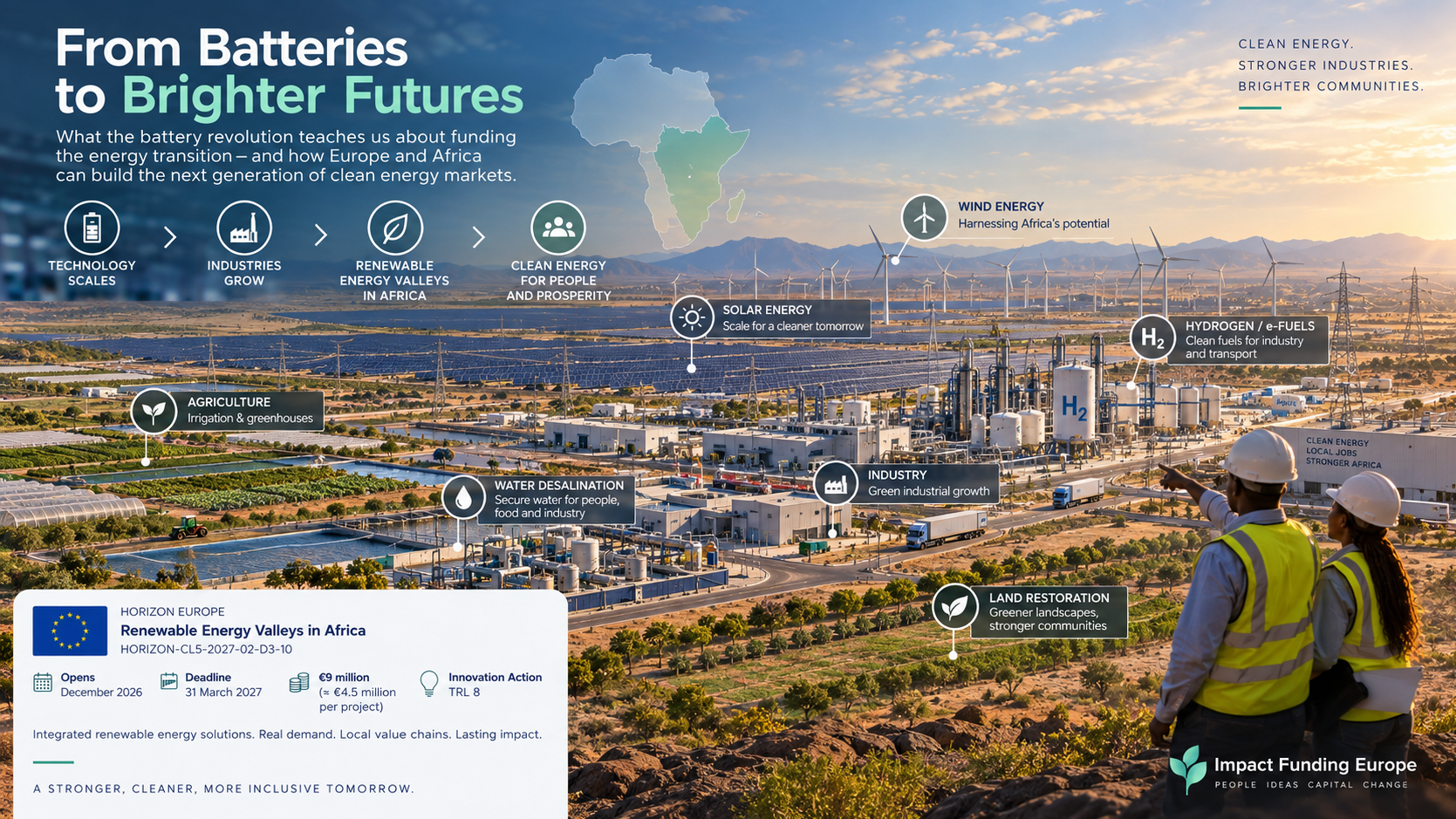
The precise Horizon Europe topic is “Renewable Energy Valleys in Africa to increase energy security and energy access in Africa”, identified as HORIZON-CL5-2027-02-D3-10. It concerns integrated renewable-energy demonstrations, rather than a dedicated subsidy for standalone battery factories.
Funding snapshot. As of 19 September 2026, the call is forthcoming, with opening scheduled for December 2026. The published work programme specifies a deadline of 31 March 2027 at 17:00 Brussels time, an indicative topic budget of euro 9 million, and an expected EU contribution of approximately euro 4.5 million per project, with two projects envisaged. These are indicative contributions, not guaranteed awards or total project investment budgets.
The topic is an Innovation Action, targeting Technology Readiness Level 8 by project completion. Alongside the general Horizon Europe consortium rules, it requires at least two beneficiaries established in at least two different African Union member states. Entities established in all African Union member states are exceptionally eligible for EU funding under this topic.
The scope is broader than installing generation equipment. It encompasses designing, constructing, commissioning and operating a demonstration in Africa, while addressing local energy needs, grid considerations, manufacturing value chains, workforce skills and a route to commercial deployment. African small and medium-sized enterprises are expected to play an important role.
For prospective consortia, that combination is the significant point. A renewable energy valley should be conceived as a functioning local energy economy, not merely a collection of technologies.
Consider an illustrative configuration: renewable electricity and storage serving an industrial or agricultural cluster, with productive energy demand, shared maintenance capabilities and training for local technicians. Renewable heat or fuels could form part of the system where justified by local needs and resources. This is an example of project logic, not a prescribed technology combination.
The commercial questions would remain central: who operates the system, who pays for its services, how tariffs remain affordable, how maintenance and replacement are financed, and how the model can be replicated.
The call explicitly asks for a market and business strategy, including consideration of financial instruments and development-finance programmes. It also addresses community governance, circularity, life-cycle impacts and the connections between water, energy, food and ecosystems.
Our interpretation is clear: the grant should demonstrate both a technical solution and a credible route to continued operation and wider deployment.
Local value creation should therefore be designed into the project from the beginning–not added as a paragraph about impact at the end.
What this means for project preparation
The practical starting point is not to assemble the largest possible technology portfolio. It is to define a coherent project in which demand, infrastructure, operating responsibility and finance fit together.
For an African renewable energy valley, we would begin with the local need and the proposed site. From there, the consortium should establish the energy balance, identify participating customers and operators, assess local supplier opportunities, and develop the investment and operating model.
Delivery readiness also matters. The topic makes demonstrated access to land and/or operating permits–or convincing management of the risk of delay–a major element of the implementation assessment.
At Impact Funding Europe, our work connects project development, consortium building, funding identification and proposal preparation. Financial modelling and financing strategy help connect the project narrative with the practical requirements of implementation.
Applied to this opportunity, that means developing the technical demonstration and its commercial logic together. It also means distinguishing the Horizon Europe-funded action from any wider investment programme: other grants, loans, guarantees or private capital would require their own eligibility and financing assessment.
The real question is what happens after the grant
The wrong question is: How much subsidy is needed to persuade someone to build a factory?
The better question is: How do we create a market in which companies can invest, learn, serve customers and reduce costs over the next decade?
Our conclusion from the battery experience is that innovation, dependable demand, patient capital and sustained policy need to reinforce one another. The opportunity for Europe–and for collaborative renewable energy projects in Africa–is to translate that principle into project design.
A successful demonstration should leave more than equipment behind. It should leave operating capability, commercial relationships, local expertise and a credible next investment.
Planning a renewable energy valley or an industrial decarbonisation project? Contact Impact Funding Europe to discuss the project concept, consortium and funding pathway.
Source acknowledgement: This article builds on the IEA commentary “The rise of lithium-ion batteries” by Teo Lombardo, Ivo Walinga, Rebecca McKimm, Simon Bennett and Timur Gul, published on 7 September 2026 under CC BY 4.0.