
IPCEI CIC Funding: Compute Infrastructure Continuum for Sovereign Cloud, Edge and AI Infrastructure
IPCEI CIC, the Important Project of Common European Interest on Compute Infrastructure Continuum, is an emerging European funding opportunity for companies developing sovereign, distributed and AI-ready digital infrastructure.
The initiative focuses on Europe’s next-generation compute infrastructure: cloud, edge, data centres, distributed data processing, orchestration, interoperability, cybersecurity and the infrastructure needed to train, deploy and run AI and industrial digital services closer to where data is generated.
Impact Funding Europe helps companies assess whether their infrastructure projects fit IPCEI CIC, prepare for national expressions of interest, position themselves for European matchmaking and develop the technical, financial and State aid rationale required for the next stages.
Latest IPCEI CIC Tracking Note
May 2026 update: IPCEI CIC is in a project formation and expression-of-interest phase across participating Member States. The participating Member States have finalised a common project description to support national procedures such as calls for proposals and expressions of interest.
Several Member States are expected to publish IPCEI CIC Calls for Expression of Interest, while some national windows have already closed. Companies should verify their relevant national process before preparing an application, because timelines, eligibility rules and submission requirements vary by country.
What is IPCEI CIC?
IPCEI CIC is a planned Important Project of Common European Interest focused on Europe’s Compute Infrastructure Continuum: a sovereign, distributed and interoperable computing environment connecting cloud, edge, data infrastructure and AI-ready compute capacity.
The objective is to help Europe reduce dependency on non-European infrastructure providers and build a powerful digital infrastructure layer for industry, research, public services and AI deployment.
Unlike a standard EU grant call, IPCEI CIC is expected to operate through Member State-led State aid processes. National authorities identify potential projects through expressions of interest and selection procedures, while the European Commission assesses the compatibility of State aid with EU rules.
For companies, this means IPCEI CIC is not simply a grant application. It is a strategic project positioning exercise involving technology ambition, European relevance, cross-border collaboration, funding gap evidence and State aid justification.
IPCEI CIC National EoI Status as of 10 May 2026
National IPCEI CIC procedures are not synchronised across Europe. Some countries have already closed their national expression-of-interest windows, while others are expected to publish a Call for Expression of Interest.
The table below summarises the IPCEI CIC status. This should be treated as an indicative tracking snapshot only. Applicants should always verify the latest status with the relevant national authority.
| Country | IPCEI CIC status as of 10 May 2026 |
|---|---|
| Belgium | Call for Expression of Interest expected |
| Croatia | Call for Expression of Interest expected |
| Estonia | Call for Expression of Interest expected |
| Finland | Call for Expression of Interest expected |
| France | Call for Expression of Interest expected |
| Germany | Call for Expression of Interest expected |
| Hungary | Call for Expression of Interest expected |
| Lithuania | Call for Expression of Interest expected |
| Netherlands | Call for Expression of Interest expected |
| Romania | Call for Expression of Interest expected |
| Slovakia | Call for Expression of Interest expected |
| Spain | Call for Expression of Interest expected |
| Ireland | Closed · 4 February 2026 |
| Slovenia | Closed · 16 January 2026 |
| Poland | Closed · 25 March 2026 |
| Italy | Closed · 7 May 2026 |
| Austria | No IPCEI CIC window indicated in the tracker |
| Czechia | No IPCEI CIC window indicated in the tracker |
| Portugal | No IPCEI CIC window indicated in the tracker |
| Sweden | No IPCEI CIC window indicated in the tracker |
Important note: “Call for Expression of Interest expected” means that publication of a national call has been indicated by the Member State and remains subject to revision. It does not guarantee that a call is open or that a company is eligible.
For companies, the practical implication is clear: IPCEI CIC is moving at different speeds across Member States. Companies in countries where a call is expected should prepare their project concept, infrastructure layer description, partner strategy and funding gap rationale before the national window opens. Companies in countries where the window has closed may still need to assess whether associated partner routes, future windows or alternative funding instruments are available.
Why IPCEI CIC Matters
Europe’s demand for secure and scalable computing infrastructure is increasing rapidly. AI deployment, industrial automation, smart mobility, energy systems, digital public services and data-intensive industries all require reliable cloud-edge infrastructure and high-performance data processing.
At the same time, Europe faces strategic challenges:
- dependence on non-European cloud and infrastructure providers;
- limited access to sovereign AI-ready compute capacity;
- fragmented cloud, edge and data infrastructure markets;
- growing demand for low-latency data processing close to the data source;
- cybersecurity, data governance and resilience concerns;
- rising energy and sustainability pressures for data centres and compute infrastructure;
- the need for interoperable infrastructure across Member States;
- insufficient plug-and-play infrastructure for industrial AI adoption;
- lack of certified trust and limited availability of open, interoperable AI and cloud services;
- vendor lock-in risks caused by proprietary infrastructure models.
The common IPCEI CIC project description also highlights the strategic compute gap facing Europe. It notes that worldwide AI compute capacity is heavily concentrated outside Europe, while European industry needs better access to compute, cloud, edge, software and AI infrastructure to remain competitive.
IPCEI CIC is designed to address these challenges by supporting projects that contribute to a European compute infrastructure continuum: distributed, secure, interoperable and aligned with Europe’s digital sovereignty objectives.
Who Should Consider IPCEI CIC?
IPCEI CIC may be relevant for companies and organisations active in:
- cloud infrastructure;
- edge computing;
- data centre development and operation;
- AI infrastructure and compute capacity;
- distributed data processing;
- telecoms and connectivity infrastructure;
- cybersecurity and trusted digital infrastructure;
- infrastructure orchestration and interoperability;
- platform engineering and software infrastructure;
- high-performance computing services;
- energy-efficient compute technologies;
- industrial digitalisation and mission-critical cloud-edge applications.
The best-fit applicants will usually have projects that are ambitious, capital-intensive, technically innovative and strategically relevant to Europe’s digital infrastructure needs.
What Types of Projects Could Fit IPCEI CIC?
IPCEI CIC is likely to be most relevant for infrastructure projects that contribute to sovereign European cloud-edge and compute capabilities.
According to the common project description, IPCEI CIC focuses on two broad areas: infrastructure deployment and federation of sovereign EU-wide cross-border interconnected infrastructures. This means projects should not only deploy capacity, but also contribute to a coherent European network based on interoperability, open access, secure operation and energy-efficient compute.
Scalable Cloud and Edge Infrastructure
Projects deploying scalable Infrastructure-as-a-Service, cloud, edge or hybrid infrastructure that can support secure, distributed computing across Europe.
Data Centres and Compute Nodes
Projects involving strategic data centre deployment, regional compute nodes, AI-ready infrastructure or infrastructure that can be integrated into a wider European compute continuum.
Distributed Data Processing
Projects that allow data to be processed closer to where it is generated, reducing latency and supporting industrial, public-sector or mission-critical applications.
AI-Ready Compute Infrastructure
Projects that provide the infrastructure required to train, fine-tune, deploy or operate AI models and AI-enabled services in Europe.
Federation, Orchestration and Interoperability
Projects enabling multiple providers, infrastructure layers and platforms to operate together through common rules, technical frameworks, orchestration layers and seamless workload transfer between cloud and edge nodes.
Secure and Trusted Digital Infrastructure
Projects that strengthen cybersecurity, data protection, confidentiality, operational resilience, zero-trust models, privacy-preserving execution and trust in European cloud-edge environments.
Energy-Efficient and Sustainable Compute
Projects that improve the environmental performance of computing infrastructure, including energy efficiency, heat reuse, workload optimisation or lower-carbon data infrastructure.
Mission-Critical Cloud-Edge Use Cases
Projects enabling cloud-edge applications in sectors such as manufacturing, energy, logistics, mobility, health, public services, smart cities or defence-adjacent critical infrastructure.
Infrastructure Layers in the IPCEI CIC Compute Continuum
IPCEI CIC should not be presented as a single type of infrastructure, such as data centres or cloud. The concept is broader. It covers a continuum of interconnected infrastructure layers, from large cloud facilities to edge nodes very close to where data is generated.
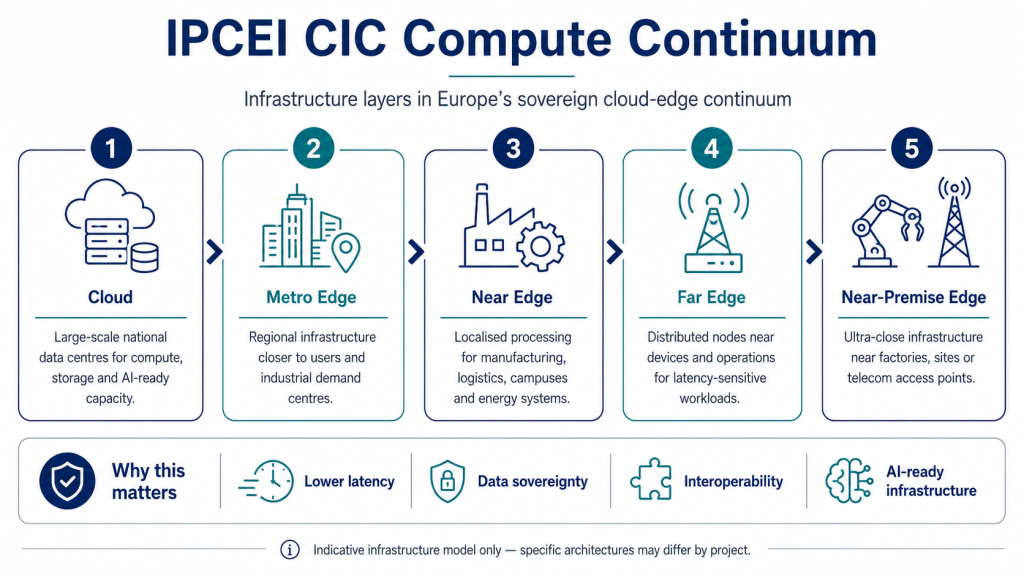
The common project description distinguishes between cloud and several edge layers. The main difference between these layers is the trade-off between scale, latency, distance from the user or data source, and operational availability.
| Infrastructure layer | Typical role in the compute continuum | Indicative technical profile |
|---|---|---|
| Cloud | Large in-country data centres for high-scale compute, storage, virtualisation, containerisation and AI-ready capacity. | Up to 50 MW; latency 20 ms or more; distance 1,000 km or more; very high availability. |
| Metro Edge | In-country edge infrastructure closer to users and industrial demand centres; suitable for regional workload processing and AI inference. | Up to 15 MW; latency up to 20 ms; distance up to 1,000 km; very high availability. |
| Near Edge | Regional/local edge infrastructure for faster response times and localised processing, including industrial AI, logistics and energy systems. | Up to 5 MW; latency up to 10 ms; distance up to 500 km; very high availability. |
| Far Edge | Highly distributed infrastructure close to devices and local data sources; relevant for real-time monitoring, mobility and industrial automation. | Up to 1 MW; latency up to 5 ms; distance up to 100 km; high availability. |
| Near-Premise Edge | Infrastructure located very close to the user, factory, campus, telecom node or operational site for ultra-low latency and sensitive data processing. | Up to 200 kW; latency up to 1 ms; distance up to 5 km. |
Cloud Layer
The cloud layer provides high-capacity compute and storage. It is relevant for large-scale workloads, AI model training, enterprise cloud services, virtual machines, containers, clusters, bare-metal services and data-intensive processing. In an IPCEI CIC context, the cloud layer should not be isolated. It should be able to connect with edge layers through common architectures, interoperability mechanisms and workload orchestration.
Metro Edge Layer
The metro edge layer brings compute capacity closer to regional users and demand centres. It can support lower-latency workloads while retaining data-centre-grade infrastructure. For companies, this may be relevant where the project serves industrial clusters, urban digital services, regional AI hubs or cloud-edge applications that need stronger local presence than central cloud infrastructure can provide.
Near Edge Layer
Near edge infrastructure supports faster response times and more localised processing. It can be particularly relevant for manufacturing, logistics, energy systems, campuses, ports, airports, mobility corridors and industrial sites where data should be processed closer to operations. Projects in this layer should explain why local processing creates value compared with centralised cloud-only solutions.
Far Edge Layer
Far edge infrastructure is closer to operational devices, sensors and users. It is relevant where latency, bandwidth, resilience or data sovereignty requirements prevent all processing from being moved to a central cloud. Examples may include connected vehicles, drones, autonomous systems, smart grid assets, industrial robotics or real-time quality control.
Near-Premise Edge Layer
Near-premise infrastructure is the closest layer to the end user or data source. It can be deployed near a factory, telecom access point, campus, hospital, transport hub or other mission-critical environment. This layer is especially relevant for ultra-low-latency applications, sensitive data processing, privacy-preserving execution, secure identity verification, network slicing and applications where data should remain close to the source.
What This Means for Applicants
Applicants should avoid describing infrastructure only in generic terms such as cloud platform or data centre. A stronger IPCEI CIC concept should explain:
- which layer or layers of the compute continuum the project addresses;
- why the selected infrastructure layer is needed for the target use case;
- how the infrastructure connects to other cloud or edge nodes;
- how workloads can move or be orchestrated across the network;
- how the project supports interoperability and avoids vendor lock-in;
- how users can access the infrastructure on open and non-discriminatory terms;
- how security, resilience, data protection and energy efficiency are built into the design;
- how the infrastructure enables AI, industrial digitalisation or mission-critical services.
This level of detail is important because IPCEI CIC is not only about deploying capacity. It is about creating a federated, sovereign and interoperable European compute infrastructure that can support future AI and industrial use cases.
Example Application Scenarios for IPCEI CIC
Near-Premises Infrastructure and Telco Edge Nodes
Near-premises infrastructure, including telco edge nodes, can provide compute capacity directly integrated into telecommunications networks. This can support ultra-low latency, reliable connectivity, data sovereignty, network slicing, optimised routing and edge applications close to where data is generated.
Satellites for AI Factories and AI Gigafactories
Regional AI infrastructure nodes can complement large AI Factories and AI Gigafactories by supporting smaller and specialised models, data pre-processing, fine-tuning, hosting and industry-specific AI services. These nodes can help create an EU-wide infrastructure network through workload balancing and standardised interfaces.
Autonomous Driving and Advanced Driver Assistance Systems
Autonomous driving and ADAS use cases require integrated cloud-edge infrastructure for model training, simulation, testing, validation, data storage, secure communication and over-the-air updates. This shows how mobility applications can depend on both embedded computing and external cloud-edge capacity.
Zero-Trust and Privacy-Preserving Edge Execution
Zero-trust edge scenarios can allow sensitive data processing to remain close to the source while only non-sensitive metadata or governance elements are handled centrally. This is relevant for applications requiring strict data governance, identity verification, consented data flows, cryptographic assurance and auditability.
How IPCEI CIC Relates to IPCEI AI, IPCEI CIS and 8ra
IPCEI CIC should be understood as part of Europe’s wider digital sovereignty agenda. See how IPCEI AI may use Europe’s sovereign cloud-edge infrastructure.
IPCEI AI focuses on AI technologies, models, deployment, operations and industrial use cases. IPCEI CIC focuses on the infrastructure layer that can support those technologies: cloud, edge, data processing and compute capacity.
IPCEI CIS is also relevant because it supports the development of interoperable, energy-efficient and trustworthy cloud-edge distributed data processing technologies. IPCEI CIC should complement the existing developments from IPCEI CIS and the 8ra Initiative, particularly where infrastructure needs to use interoperable cloud-edge reference architectures and multi-provider operation.
The 8ra Initiative is also highly relevant. 8ra is building a sovereign, interoperable and secure multi-provider cloud-edge continuum for Europe. IPCEI CIC is closely connected to this agenda because it focuses on the compute infrastructure needed to support distributed data processing and AI deployment across Europe.
| Initiative | Main role |
|---|---|
| IPCEI CIC | Infrastructure layer: sovereign compute, cloud, edge, data processing and AI-ready capacity. |
| IPCEI AI | Intelligence layer: AI models, services, applications, deployment and operations. |
| IPCEI CIS | Foundation layer: interoperable, trustworthy and energy-efficient cloud-edge technologies and services. |
| 8ra Initiative | Ecosystem and architecture layer: interoperable multi-provider cloud-edge continuum. |
Companies working in digital infrastructure should assess whether their project fits IPCEI CIC, IPCEI AI, IPCEI CIS-related exploitation routes, 8ra-related opportunities or another European funding route. You can also explore IPCEI opportunities beyond digital infrastructure, or explore all upcoming IPCEI funding opportunities in Europe.
Is Your Project IPCEI CIC-Ready?
1. Does the project contribute to European digital sovereignty?
The project should strengthen Europe’s ability to control, operate or access critical compute infrastructure.
2. Is the project beyond normal commercial deployment?
Routine data centre expansion, ordinary cloud migration or standard IT infrastructure upgrades are unlikely to be enough. The project should involve innovation, integration, scale, risk or strategic relevance beyond business as usual.
3. Is there a clear market failure or funding gap?
The company must be able to explain why the project would not happen in the same form, scale, timing or location without public support.
4. Does the project have cross-border relevance?
IPCEIs are European by nature. A strong project should connect to other Member States, European value chains, interoperability objectives or cross-border infrastructure needs.
5. Can the company demonstrate positive spillovers?
The project should generate benefits beyond the applicant, such as standards, interoperability, open interfaces, open and non-discriminatory access, ecosystem development, supplier opportunities, training, knowledge sharing or wider industrial access.
6. Is the internal team ready for the workload?
IPCEI preparation can require detailed technical documentation, financial modelling, partner coordination, confidential information sharing and responses to questions from national authorities and the European Commission.
How the IPCEI CIC Process Usually Works
The exact process depends on each Member State, but companies should normally expect a structured pathway.
National Expression of Interest
A national authority opens a call or screening process to identify companies with projects that could fit IPCEI CIC.
Initial Project Assessment
The project is assessed against national priorities, IPCEI scope, innovation level, strategic relevance, expected spillovers and possible State aid justification.
European Matchmaking
Selected companies may be invited to international matchmaking to identify cross-border partners and define how individual projects fit into the wider European structure.
Full Project Proposal Development
Companies prepare more detailed technical, financial and strategic material. This may include project descriptions, work packages, investment planning, funding gap analysis, impact logic and spillover commitments.
Chapeau and Individual Documentation
The integrated IPCEI is usually described in an overarching chapeau document, while each company prepares individual project documentation explaining its specific contribution.
State Aid Notification and Commission Review
Member States submit the notification to the European Commission. The Commission reviews the project under State aid rules, including necessity, proportionality, eligible costs, funding gap, innovation level, market effects and European spillovers.
Approval, Funding Agreement and Implementation
If the Commission approves the State aid and the Member State confirms the national funding decision, the company can move toward implementation, reporting and delivery obligations.
What to Prepare for an IPCEI CIC Expression of Interest
Companies interested in IPCEI CIC should prepare early. A strong EoI package may require:
- a concise project summary;
- company description and role in the digital infrastructure value chain;
- explanation of the technology and infrastructure being developed;
- description of why the project is beyond the state of the art;
- investment amount and high-level cost categories;
- expected timing and implementation milestones;
- explanation of the market failure or funding gap;
- potential cross-border partners or partner types;
- expected positive spillovers;
- contribution to European digital sovereignty and competitiveness;
- internal decision documents, business case or investment rationale;
- confidentiality-ready technical and financial evidence.
The earlier this material is prepared, the easier it becomes to respond when national windows open or matchmaking opportunities arise.
Who is involved? National points of contact
Information on the details of the programme and funding procedures of the respective Member State can be obtained via the national points of contact listed below. This section supports users without distracting from Impact Funding Europe’s advisory CTA.
Show national points of contact
| MS | National point of contact | Responsible entity |
|---|---|---|
| DE | 8ra@bmwe.bund.de | Federal Ministry for Economic Affairs and Energy · Division IVA3 |
| EE | alice.liblik@eis.ee | Estonian Business and Innovation Agency · Enterprise Estonia |
| ES | ipcei.setelco@digital.gob.es | Ministry of Digital Transformation |
| FI | sini.kahilaniemi@businessfinland.fi | Ministry of Economic Affairs and Employment of Finland |
| FR | piiec-cic.dge@finances.gouv.fr | Ministry of the Economy, Finance and Industrial and Digital Sovereignty |
| HU | ipcei@ngm.gov.hu | Ministry for National Economy, Department for Industry Relations |
| IE | ipcei@enterprise.gov.ie | Ministry of Enterprise Tourism and Employment · IPCEI team |
| IT | dgind.div5@mise.gov.it | Ministry of Enterprises and Made in Italy · Directorate General for Industrial Policies |
| PL | ipcei-cic@mrit.gov.pl | Ministry of Development and Technology, Department of Innovation and Industrial Policy |
| SK | ipcei_ai_cic@mirri.gov.sk | Ministry of Investments, Regional Development and Informatization |
| SI | ipcei.mgts@gov.si | Ministry of the Economy, Tourism and Sport |
IPCEI CIC vs Other Funding Routes
IPCEI CIC may not be the best route for every cloud, edge or AI infrastructure project. Depending on the project scope, maturity and country, companies may also need to consider the Digital Europe Programme, Horizon Europe, EuroHPC-related opportunities, national R&D and industrial innovation schemes, regional infrastructure funding, InvestEU and blended finance, green data centre or energy-efficiency support, or private debt, project finance and strategic equity. Impact Funding Europe can help compare these options and identify the most realistic route for your project.
Official sources
How Impact Funding Europe Can Help
Impact Funding Europe supports companies from early IPCEI fit assessment to expression-of-interest strategy and preparation.
IPCEI CIC Eligibility and EoI Audit
We assess whether your project fits the expected scope of IPCEI CIC and whether it has the strategic relevance, innovation level and funding gap profile required.
Project Concept Development
We help translate technical infrastructure plans into a strong funding narrative focused on European digital sovereignty, cloud-edge infrastructure, AI-ready compute capacity and market failure rationale.
National Process and Opportunity Mapping
We identify which national process may be relevant for your company and help monitor upcoming EoI windows, templates and submission requirements.
Partner and Matchmaking Strategy
We help define the types of European partners needed to strengthen your project and position it within a cross-border compute infrastructure continuum.
Funding Gap and Business Case Support
We support the development of the financial logic needed to explain why public support is necessary and proportionate.
Chapeau and Individual Project Documentation
We support the preparation of individual project documentation and input into broader IPCEI-level narratives.
Alternative Funding Route Analysis
If IPCEI CIC is not the right fit, we help identify alternative European, national or blended finance routes.
Start Preparing for IPCEI CIC
Companies interested in IPCEI CIC should not wait until every detail is finalised. National expressions of interest can move quickly, and companies that prepare early are better placed to define their role, find partners and develop a credible funding case.
If your organisation is planning a major project in cloud, edge, data centres, AI infrastructure, distributed computing or sovereign digital infrastructure, Impact Funding Europe can help you assess whether IPCEI CIC is the right route.
You may also want to review our European funding strategy and application support.
Ready to assess your IPCEI CIC route?
IPCEI CIC FAQ
What does IPCEI CIC stand for?
IPCEI CIC stands for Important Project of Common European Interest on Compute Infrastructure Continuum.
What is the purpose of IPCEI CIC?
The purpose of IPCEI CIC is to support the development of sovereign, distributed and interoperable computing infrastructure in Europe, including cloud, edge, distributed data processing and AI-ready compute capacity.
Is IPCEI CIC a normal EU grant call?
No. IPCEI CIC is not a standard EU grant call. It is expected to operate through Member State-led State aid processes, with national expressions of interest and European Commission State aid assessment.
Who should consider IPCEI CIC?
Cloud providers, edge computing companies, data centre operators, AI infrastructure providers, telecoms, cybersecurity companies, orchestration platforms and software infrastructure companies should assess whether IPCEI CIC is relevant.
Can data centre projects qualify for IPCEI CIC?
Potentially, but a standard data centre investment is unlikely to be enough. The project should contribute to a wider European compute infrastructure continuum and demonstrate innovation, strategic relevance, interoperability, sustainability or AI-ready infrastructure value.
How is IPCEI CIC connected to IPCEI AI?
IPCEI CIC focuses on the infrastructure layer, while IPCEI AI focuses on AI technologies and applications. AI deployment depends on secure, scalable and sovereign compute infrastructure, which makes the two initiatives complementary.
What is an IPCEI CIC expression of interest?
An expression of interest is an early national screening process used to identify companies and projects that may fit the future IPCEI. Submitting an EoI does not guarantee funding.
What should companies prepare first?
Companies should prepare a clear project concept, initial investment plan, innovation narrative, funding gap rationale, possible cross-border partner strategy and evidence of positive European spillovers.
Can SMEs participate in IPCEI CIC?
Yes, SMEs may be able to participate depending on the national process and their role in the value chain. Some may participate as direct participants, associated partners or through linked ecosystem roles.
How can Impact Funding Europe help with IPCEI CIC?
Impact Funding Europe can help assess project fit, prepare expression-of-interest material, develop the funding narrative, support funding gap logic, identify partner needs and compare IPCEI CIC with alternative funding routes.
IPCEI CIC scope, timelines, eligibility rules and funding routes depend on Member State participation, national budget decisions and European Commission State aid approval. This page is for general information and does not constitute legal advice or a guarantee of funding.