By Yasir Khan · Published 2 November 2026
Portfolio scale, investment potential, climate ambitions and the challenge of delivery
Europe’s transition to a climate-neutral economy requires more than ambitious targets and promising technologies. It requires investment in industrial facilities, energy infrastructure and innovative processes capable of reducing emissions at commercial scale.
The European Union’s Innovation Fund was established to help meet that challenge. Financed through revenues from the EU Emissions Trading System (EU ETS), it supports the demonstration and deployment of innovative low-carbon technologies across energy-intensive industries, renewable energy, energy storage, industrial carbon management and other eligible sectors.
In July 2026, the European Commission published its evaluation of the Fund’s operation. The report assesses how the Fund has developed since its first calls in 2020, including its ability to mobilise investment, its expected climate contribution and the practical obstacles that can delay projects after selection.
The findings offer an important message for companies, investors and policymakers: the Innovation Fund has become a significant instrument for de-risking industrial decarbonisation, but committed funding and projected emissions reductions are not the same as completed investment and verified climate outcomes.
1. A fund designed to bridge the gap between innovation and deployment
Many low-carbon technologies face a difficult transition from technical demonstration to commercial-scale operation. A technology may perform well in a laboratory or pilot facility but still require substantial capital expenditure, industrial validation, infrastructure and a reliable market before it can be deployed at scale.
The Innovation Fund is intended to help address these barriers by supporting innovative technologies with significant potential to reduce greenhouse gas emissions. In doing so, it complements research-focused programmes such as Horizon Europe, which often support earlier stages of research and demonstration, while the Innovation Fund targets later-stage demonstration and deployment.
The Commission’s evaluation identifies evidence of connections between the programmes. Of 38 known projects previously supported by FP7, Horizon 2020 or Horizon Europe that subsequently applied to the Innovation Fund, 13 obtained funding. The resulting 32.5% success rate was above the 12% overall portfolio rate reported in the evaluation. However, the Commission notes that this is a small sample and does not establish that earlier research funding itself caused the higher success rate.
Why this matters
The Fund addresses a real financing challenge: projects can be technologically promising while remaining too capital-intensive, commercially uncertain or infrastructure-dependent to secure investment on ordinary market terms.
2. Portfolio growth and a strong industrial focus
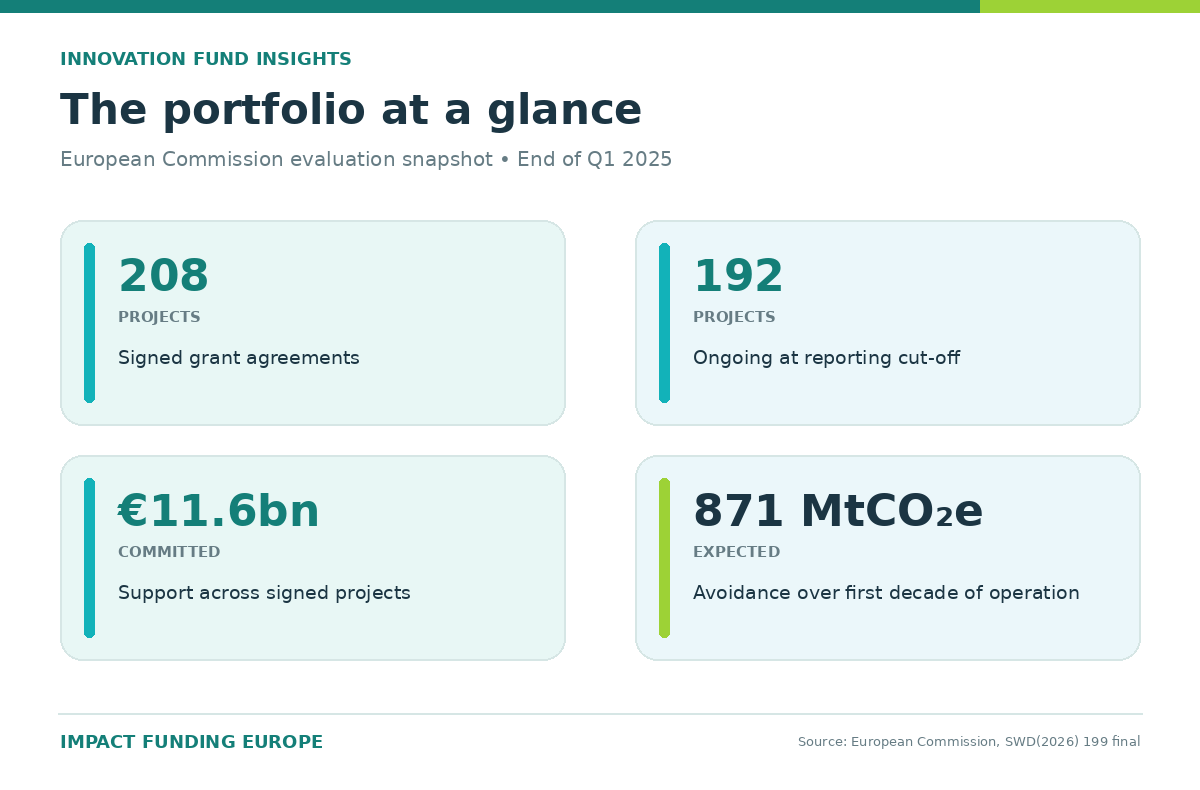
By the end of March 2025, the Commission’s evaluation recorded 208 projects with signed grant agreements and €11.6 billion in committed support. Of these projects, 192 were ongoing and 16 had been terminated by the evaluation cut-off.
The portfolio spans multiple technologies and sectors, but energy-intensive industries account for more than half of projects. Hydrogen, chemicals, cement and lime, refineries, and iron and steel feature prominently. Renewable energy, energy storage, industrial carbon management, clean-tech manufacturing and mobility broaden the portfolio and address different parts of the transition.
This focus reflects the scale of the decarbonisation challenge. Heavy industry often depends on long-lived assets, high-temperature processes, feedstocks and supporting infrastructure. Changing those systems can require integrated investments rather than a single equipment upgrade.
The portfolio has also expanded across eligible countries, but support remains concentrated in larger industrial economies. The Commission links participation not only to the quality of project proposals, but also to national industrial capacity, availability of co-financing and the support available through public administrations and innovation ecosystems.
3. Investment mobilisation: public grants as a catalyst
One of the Innovation Fund’s central objectives is to help unlock investment that might otherwise be difficult to secure for innovative low-carbon projects. On this measure, the Commission’s evaluation reports a substantial volume of expected or planned investment associated with its grants.
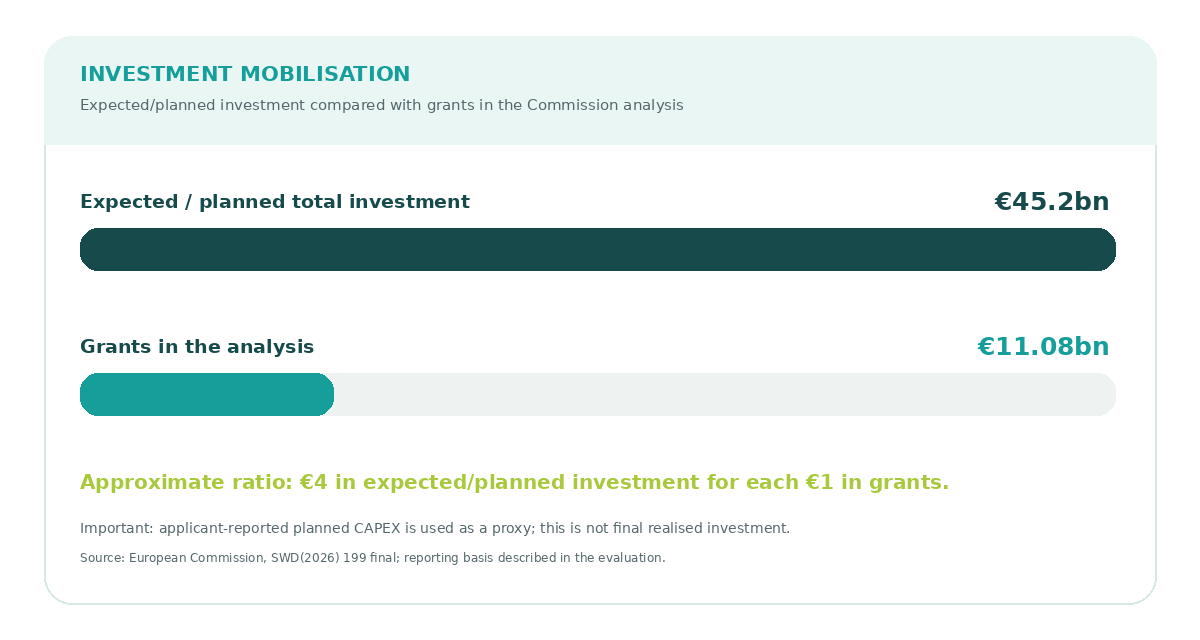
In the evaluation’s investment-leverage analysis, approximately €45.2 billion in total expected or planned investment was associated with €11.08 billion in grants – a ratio of about €4 in total investment for each €1 of grant support.
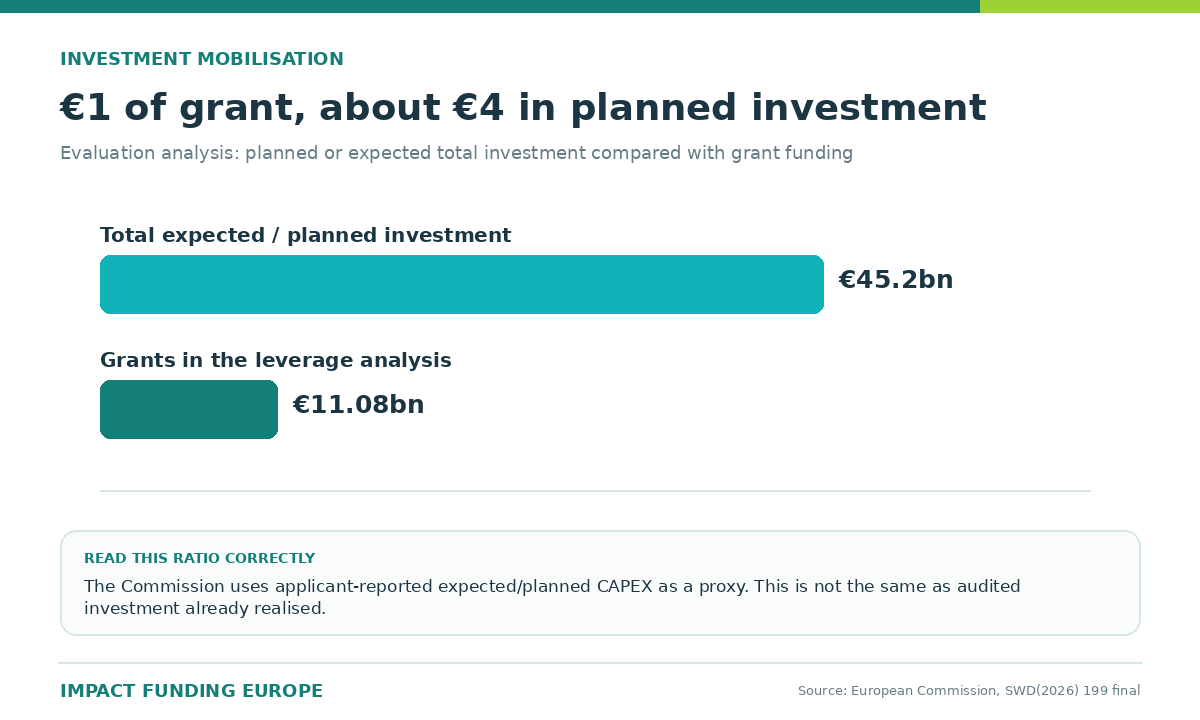
The ratio must be interpreted carefully. The Commission uses applicant-reported expected or planned capital expenditure as a proxy for investment mobilisation. More reliable data become available when projects reach financial close. The ratio is therefore evidence of the portfolio’s expected investment potential, not proof that all the investment has already been made or that every euro represents additional private capital over and above the grant.
The important distinction
The €11.6 billion portfolio figure above describes committed support across signed projects. The €11.08 billion figure is the grant amount used in the evaluation’s leverage analysis. They refer to different measures within the same evaluation and should not be substituted for one another.
The broader rationale remains important: public support can reduce some risks around first-of-a-kind projects, strengthen the financing proposition and help attract additional capital. But a grant does not replace the need for a credible business model, a bankable financial plan and a realistic path to implementation.
4. Climate impact: significant potential, still prospective
The Commission estimates that the 192 ongoing projects in the Q1 2025 portfolio were expected to avoid 871 million tonnes of CO₂ equivalent over their first decade of operation. Hydrogen and related manufacturing, cement and lime, iron and steel, and chemicals were among the largest contributors to this projected avoidance.
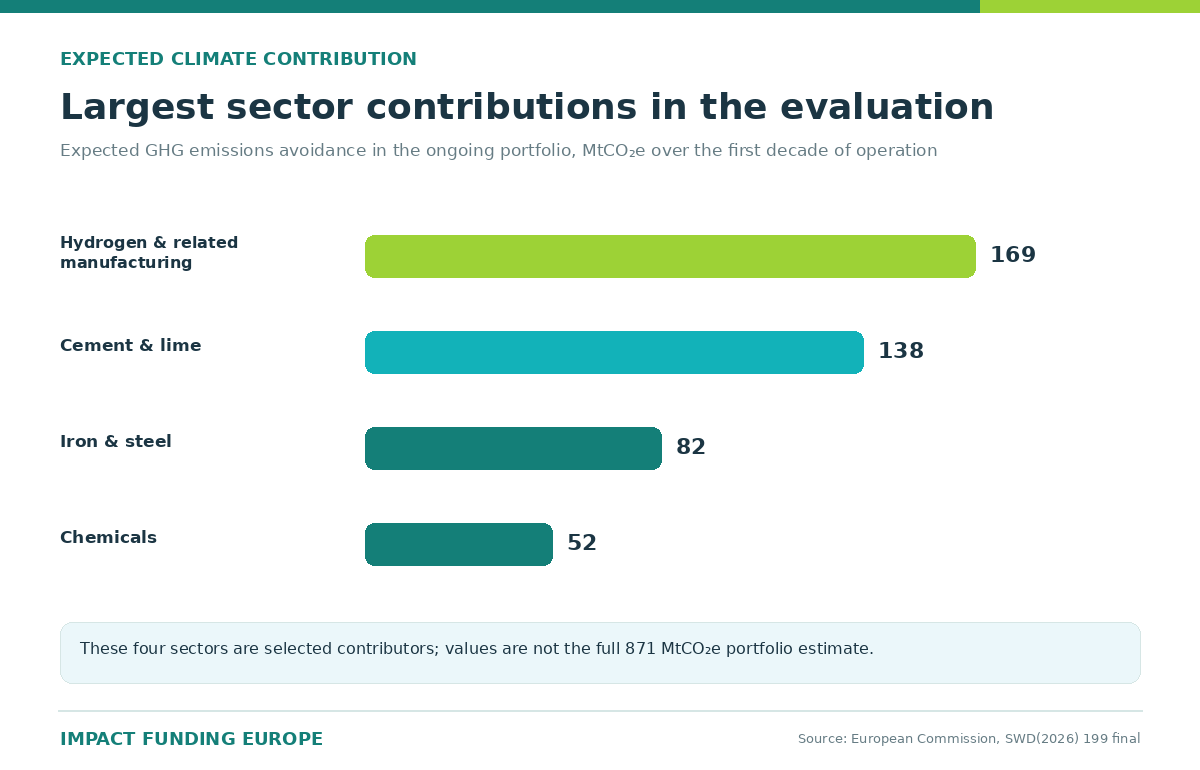
The figure shows the potential scale of the Fund’s contribution, particularly in sectors where emissions are difficult to reduce. It should not, however, be read as a record of reductions already achieved. At the evaluation cut-off, many supported projects were still in early implementation, construction or pre-operation stages.
The Commission therefore uses expected emissions avoidance to assess the portfolio’s potential. It also acknowledges that there is not yet enough operating evidence to draw definitive conclusions about the overall realised emissions-reduction performance of the Fund.
For policymakers and project developers alike, the eventual test is whether supported projects are commissioned, operate as planned and deliver the reductions on which their funding cases were built.
5. What does the €279 billion benefits estimate mean?
The evaluation also assesses the Fund through a cost-benefit framework. The Commission estimates total net quantifiable benefits of approximately €279 billion over the 2020–2030 programme funding period. Its model produces a benefit-cost ratio of 14.3 when measured against the EU contribution and 2.5 when all costs, including national and private co-financing, are included.
These are modelled estimates, not cash returns earned by the Fund or its beneficiaries. The quantified benefit calculation is based on the monetary value assigned to expected greenhouse gas emissions avoided. It should not be described as €279 billion in direct revenue, jobs created or realised economic output.
The ratios also answer different questions. The 14.3 measure compares the modelled quantified benefits with the costs attributed to the EU contribution under the Commission’s methodology. The 2.5 measure includes the wider total cost base. Both remain dependent on assumptions about projected emissions reductions and their monetary value.
The results indicate that the Commission’s modelled climate-related benefits substantially exceed the estimated costs under both approaches. At the same time, they need to be read alongside the evaluation’s warning that the portfolio is still too early in its implementation to establish its full realised impact.
6. The independent audit: high potential, but delivery remains the test
The European Court of Auditors’ Special Report 11/2026, published in March 2026, provides an independent assessment of the Innovation Fund. Its title summarises the central concern: the Fund has high potential, but progress is slow and the impact on emissions reduction remains limited.
The audit highlights issues involving the predictability of available resources, how funding is allocated, delays and cancellations, and the risk that projects’ potential emissions reductions may be overstated. These findings do not erase the Fund’s role in supporting innovative technologies; they underline the difference between selecting projects with strong potential and delivering the expected outcomes.
The ECA reported that, by 30 June 2025, 40 of 228 projects initially selected for support had been cancelled or withdrawn: 20 before grant agreement signature and 20 after signature. This later audit figure has a different reporting date and denominator from the Commission evaluation’s Q1 2025 snapshot, which recorded 16 terminated projects among 208 projects with signed grants. The two figures should not be treated as directly comparable termination rates.
The Commission’s evaluation likewise describes implementation delays and project terminations, while noting that many difficulties stem from changing market conditions and external constraints that cannot always be predicted at application stage. Read together, the evaluation and audit point to the same central question: can the Fund convert selection and financial commitments into completed projects and verified emissions reductions?
7. Persistent challenges: demand, delays and access
Three challenges stand out from the Commission’s evaluation.
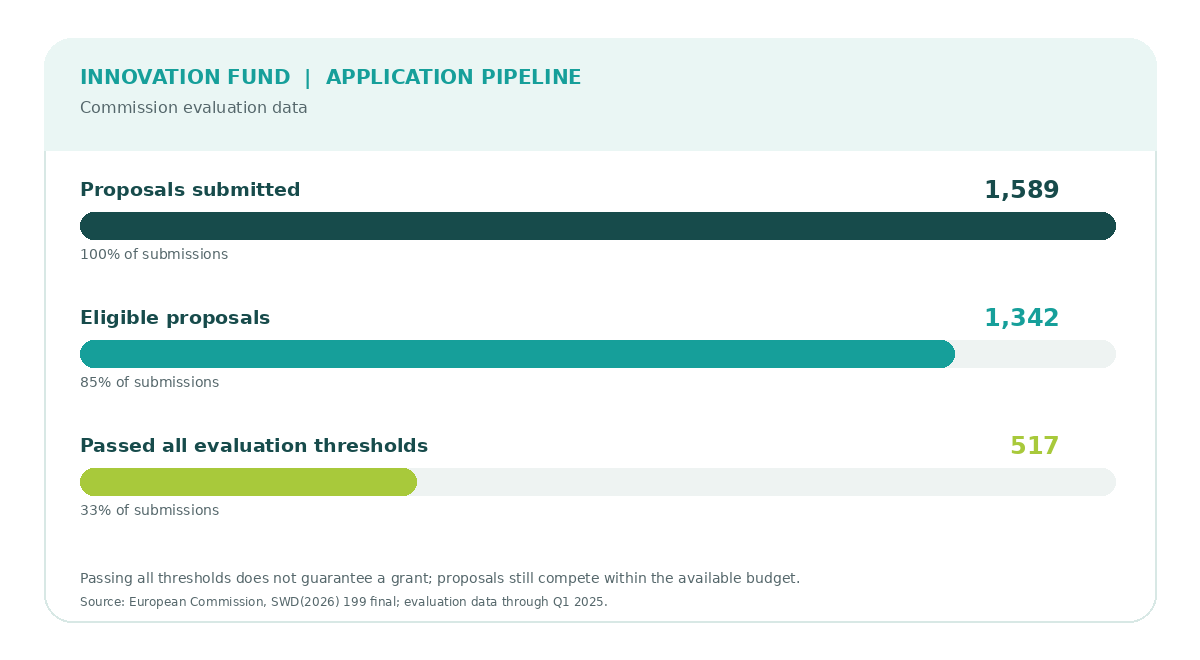
Demand exceeds the available budget. Between 2020 and 2023, applicants to regular grant calls requested more than seven times the available budget overall. The oversubscription ratio fell from 21.3 in 2020 to 5.6 in 2023, but many proposals that passed evaluation thresholds still remained unfunded. Strong demand demonstrates the relevance of the programme; it also shows that the Fund cannot finance every credible project in the pipeline.
Implementation takes time. Around 40% of projects reported delays before financial close. Among projects that had passed financial close, approximately 63% experienced delays before entering operation. The evaluation identifies financing gaps, permitting and regulatory procedures, infrastructure dependencies, supply-chain constraints, inflation and changes in market conditions as recurring causes.
Access is uneven. Projects are represented across nearly all eligible countries, but the portfolio remains concentrated in larger industrial economies. Smaller projects and SMEs can also face a disproportionate administrative burden because complex technical and reporting requirements require time and specialist support. The Commission identifies potential improvements such as more proportionate requirements, better digital tools, and continued development of Project Development Assistance and technical assistance.
These issues are related. A project can score well but remain unfunded because of budget constraints; a funded project can then face co-financing or infrastructure barriers that delay delivery. Addressing these constraints is important if the Fund is to expand its impact while maintaining robust selection and accountability.
8. What the evaluation means for Europe’s industrial transition
The evaluation presents a balanced picture. The Innovation Fund has become a major EU instrument for supporting innovative low-carbon technologies and mobilising investment for industrial decarbonisation. The scale of its portfolio and its projected climate contribution show why it matters to Europe’s industrial transition.
But the ultimate measure of success cannot be the value of grants awarded or the scale of modelled emissions avoidance alone. It must also include whether projects reach financial close, are built and commissioned, operate commercially and deliver the reductions expected of them.
For industrial companies, this means that funding should be considered as part of a wider project-development and financing strategy. Technical ambition needs to be matched by credible implementation planning, realistic financial assumptions and a clear understanding of infrastructure, permitting and market risks. For policymakers, the findings point to the importance of sufficient resources, complementary finance, effective implementation support and broader access for capable projects across sectors and countries.
The first five years show both the potential of coordinated EU-level support and the difficulty of translating innovative technologies into operating assets. The next phase will be judged by how effectively that potential becomes delivered investment and measurable climate outcomes.
How Impact Funding Europe can support your project
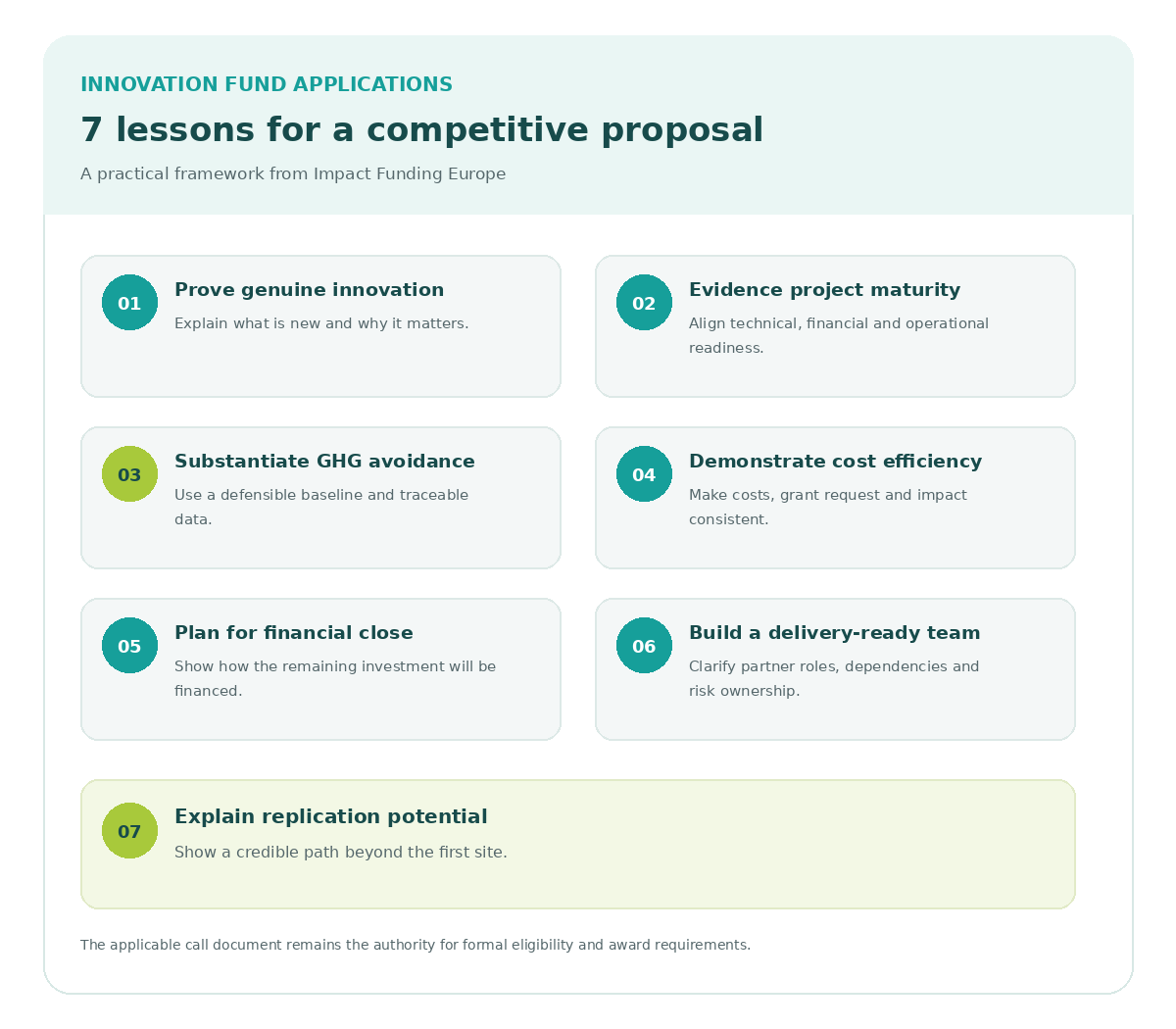
Impact Funding Europe supports organisations developing collaborative EU-funded projects, including initiatives focused on climate-neutral, digital and smart solutions. Preparing a competitive funding strategy means understanding the relevant programme, building a coherent technical and financial case, and considering implementation requirements from the outset.
Planning a low-carbon industrial investment?
Sources and reporting note
The principal portfolio, investment and benefit estimates in this article are drawn from the European Commission’s evaluation. Much of the Commission’s project and financial evidence is reported through the first quarter of 2025. The ECA cancellation/withdrawal figure uses the separate reporting cut-off of 30 June 2025 and covers projects initially selected for support, including withdrawals before a grant agreement was signed.
- [1] European Commission (2026) – Evaluation of the Innovation Fund’s operation, Commission Staff Working Document SWD(2026) 199 final
- [2] European Court of Auditors (2026) – Special Report 11/2026: Innovation Fund – High potential, but slow progress and little impact on emissions reduction
- [3] European Commission – Innovation Fund calls for proposals (verify current and future calls immediately before publication)
This article is for general information and does not replace the eligibility rules, award criteria or other conditions in the applicable Innovation Fund call documentation.