IFE Innovation Fund Article 4 Hero 1200x627

Innovation Fund GHG Calculations: How to Demonstrate Credible Emissions Avoidance

Share:

Innovation Fund Insights · Article 4 of 5

By Yasir Khan · Published 16 November 2026

For companies preparing an Innovation Fund application, greenhouse gas (GHG) emissions avoidance is a central part of the climate and technical case for funding. Applicants need to show how a project compares with an appropriate reference scenario, substantiate the assumptions behind the calculation and demonstrate that the expected reductions are credible under realistic operating conditions.

The European Commission’s 2026 evaluation identifies GHG calculation quality as an important part of proposal assessment. It notes that unrealistic or poorly substantiated emissions claims can lead to lower evaluation scores. It also cautions that, because many supported projects remain at early implementation stages, there is not yet enough evidence to assess conclusively how accurately application-stage calculations predict the emissions reductions ultimately delivered.

The European Court of Auditors (ECA) has also raised concerns about aspects of the sector-specific methodology it examined, including cases where the treatment of certain activities could overstate avoided emissions. These findings make methodological discipline important not only at submission, but also during monitoring and verification.

The practical message is straightforward: a credible GHG calculation is not necessarily the calculation with the largest headline reduction. It is the calculation that follows the applicable methodology, uses a justified reference scenario, documents its assumptions and can be checked against evidence.

KEY TAKEAWAY

Treat the GHG calculation as part of the project design and monitoring plan – not as a spreadsheet completed at the end of the application.

1. Understand what the GHG assessment measures

For regular Innovation Fund grant calls, GHG emissions avoidance is assessed alongside other criteria such as innovation, project maturity, replicability and cost efficiency. It is important, but it is not the only determinant of whether a proposal is selected. The precise criteria, score weights, thresholds and eligibility conditions are set out in the applicable call documentation.

The Commission’s methodology distinguishes three elements in the GHG assessment:

  • Absolute GHG emissions avoidance: the total expected reduction compared with the reference scenario over the prescribed assessment period, expressed in tonnes of CO₂ equivalent (tCO₂e).
  • Relative GHG emissions avoidance: the reduction expressed in relation to emissions in the reference scenario.
  • Quality of calculation: whether the method, assumptions, supporting evidence and calculations comply with the applicable rules and are presented in a robust, traceable way.

These measures answer different questions. Absolute avoidance indicates the scale of the expected climate benefit; relative avoidance expresses the reduction against the baseline; calculation quality addresses whether the resulting claim can be relied upon. Cost efficiency also depends on absolute emissions avoidance under the applicable methodology, so inputs must be consistent across the calculation and the rest of the application.

The relevant call fiche determines the scoring formula and any minimum thresholds. Applicants should not transfer a threshold from an older call or a different topic without checking that it applies to their submission.

2. Start with the correct call methodology and project scope

Before entering data, establish exactly what the proposed project will do, which product or service is the principal output, and which sector-specific methodology applies. Industrial projects often combine several processes, products or technologies. A project may, for example, manufacture a component and use it in an energy-generation process, or combine production with carbon capture and utilisation.

The applicable methodology may treat different sectors and activities differently. Applicants should therefore begin with the call text, the current GHG methodology and the required calculator. The European Climate, Infrastructure and Environment Executive Agency (CINEA) maintains the official Tools and Guidance page, which provides access to the current methodology and sector-specific examples.

The IF25 Net-Zero Technologies methodology is a useful published example of the approach, but it should not be treated as a universal rulebook for all calls. For every submission, confirm the methodology version, calculator and topic-specific provisions attached to the relevant call.

3. Establish and justify the reference scenario

The reference scenario represents the emissions expected in the absence of the proposed project, under the definitions and conditions set by the applicable methodology. The project scenario is assessed against that reference to calculate the emissions avoided.

The baseline is not a blank canvas. Depending on the sector and product, the methodology may prescribe a reference product, process, emission factor or calculation approach. Applicants should not choose a reference scenario simply because it produces a larger reduction. They should identify the principal product, use the appropriate sector section and document any deviation only where the applicable rules permit it.

A weak or incorrectly selected reference scenario can undermine the result even if the proposed technology is genuinely innovative. A baseline that assumes an unnecessarily emissions-intensive conventional alternative, for example, may exaggerate the apparent improvement. Conversely, an incorrect baseline may understate a legitimate benefit.

The application should explain why the reference scenario is appropriate and preserve supporting evidence for the inputs used. Reviewers should be able to understand what would happen without the project and how that case is consistent with the relevant methodology.
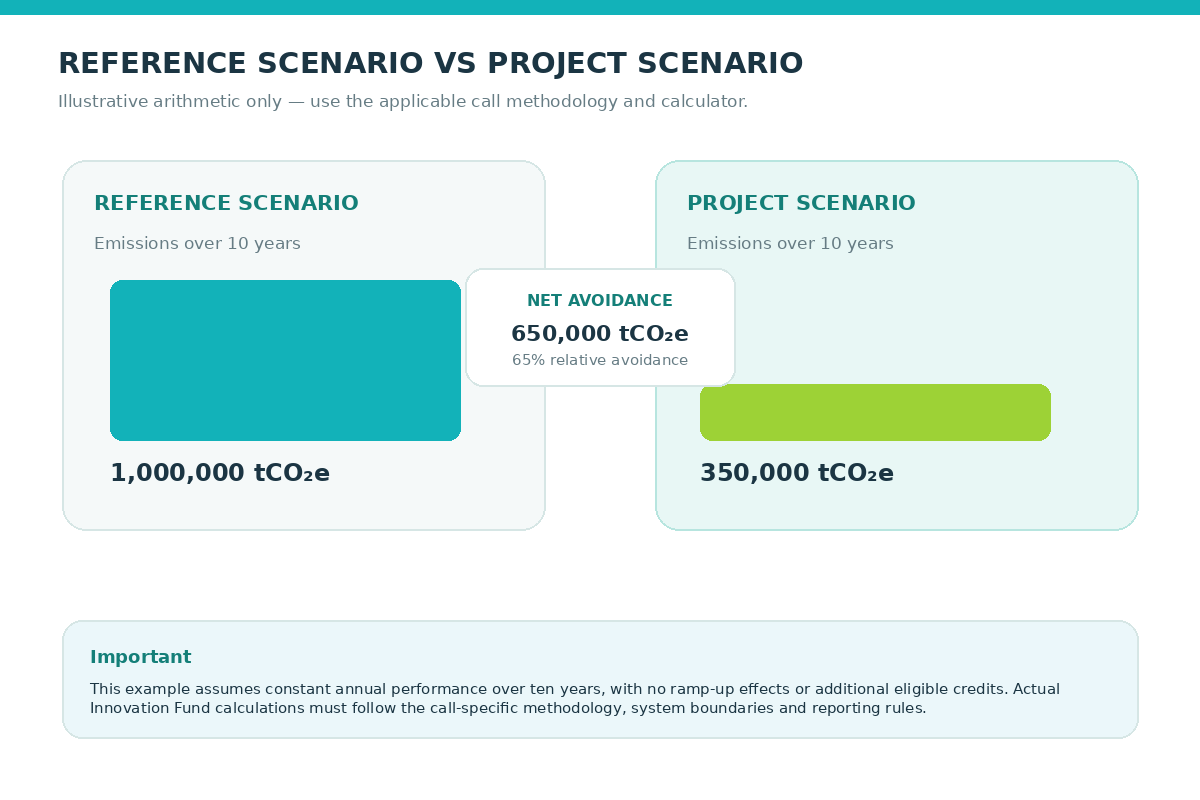
Illustrative comparison of a reference scenario of 1,000,000 tonnes CO2 equivalent over ten years and a project scenario of 350,000 tonnes, resulting in 650,000 tonnes or 65 percent relative avoidance under simplified assumptions.
Figure 1. Simplified illustration of absolute and relative avoidance. These numbers are illustrative and are not official Innovation Fund benchmarks. Source: IFE illustration; calculation concepts based on CINEA’s GHG methodology.

4. Define system boundaries and avoid double counting

The system boundary determines which processes, inputs, products and emissions are included in the comparison. Depending on the project and methodology, relevant elements may include the production process, electricity and heat, fuels, raw materials, direct process emissions, product use, transport or eligible carbon-capture credits.

Applicants should not automatically include or exclude an emissions source based on general life-cycle assessment practice. The Innovation Fund’s prescribed method takes precedence. For the applicable sector, identify the required inputs, outputs, subprocesses and system boundaries, and make sure the project and reference scenarios are treated consistently.

Double counting is a particular risk when a project spans connected activities or value chains. The same emissions saving should not be credited twice. For example, where more than one funded activity relates to the manufacture and use of the same technology, applicants need to examine the applicable sector methodology carefully and avoid overlapping claims.

The ECA’s audit highlighted potential overstatement in particular methodological treatments, including energy-storage calculations based on a device being sold rather than its actual use, and possible overlap when both solar-panel manufacturing and solar-power generation using those panels receive support. These are findings about the framework the ECA examined. They do not give applicants permission to change an official formula ad hoc; they reinforce the need to use the current call methodology and to make assumptions and system boundaries transparent.

PRACTICAL IMPLICATION

For hybrid or multi-sector projects, create a simple process-flow diagram and a boundary checklist. Show which emissions and savings are counted in each calculation, and document how overlap is prevented.

5. Substantiate every material input and assumption

A calculation is only as credible as the data and assumptions behind it. Production volumes, operating hours, capacity utilisation, energy consumption, process efficiency, feedstock use, product yields and emissions factors can all materially affect the result, depending on the sector.

For each important input, record its value, unit, source, reference period, calculation method and rationale. Make clear whether the value is measured, calculated from another parameter, taken from the prescribed methodology or based on a project assumption. Where an assumption is uncertain, explain why the selected value is reasonable and what evidence supports it.

Useful supporting evidence can include engineering studies, equipment specifications, pilot or test data, energy and material balances, supplier information, production forecasts, recognised emission factors and commercial documentation. The appropriate evidence depends on the parameter and the requirements of the relevant call.

Be particularly careful with design performance versus demonstrated performance. A technology’s nameplate efficiency or theoretical output may not reflect the operating profile of a new industrial facility. Assumptions about access to low-carbon electricity, feedstocks or product markets should be aligned with the project’s technical design and evidence of availability.

6. Model realistic operation, including ramp-up

The calculation should reflect how the project is expected to operate – not simply its best-case design performance. New industrial facilities may experience commissioning periods, process adjustments, planned shutdowns or lower performance in the early years. Where the methodology requires expected ramp-up effects to be reflected, the model should account for them explicitly.

The GHG calculation should also align with the project’s production schedule and financial model. If the business plan assumes a gradual increase in output, the emissions model should not silently assume full production from day one. Likewise, operating hours, product mix, energy use and feedstock assumptions should remain consistent across all relevant documents.

For the ten-year assessment approach used in the published IF25 NZT methodology, annual assumptions matter because an operating profile that changes over time may produce a different total than multiplying one steady-state annual value by ten. The applicable methodology determines the actual assessment period, calculation rules and treatment of any eligible credits.

7. Calculate absolute and relative avoidance transparently

Once the reference scenario, project scenario and system boundaries have been established, calculate the emissions in each scenario using the prescribed methodology. Absolute avoidance is the difference between reference and project emissions, subject to the specific treatment of eligible credits and other provisions in the applicable methodology. Relative avoidance expresses the reduction relative to the reference scenario.

A simplified illustration helps distinguish the two metrics. Assume the reference scenario emits 100,000 tCO₂e annually and the project scenario emits 35,000 tCO₂e annually. If those figures were unchanged for ten full years, and there were no ramp-up effects or additional credits, the reference total would be 1,000,000 tCO₂e and the project total would be 350,000 tCO₂e. Absolute avoidance would be 650,000 tCO₂e and relative avoidance would be 65%.

This is only the arithmetic of a simplified example. It is not an official calculator result and does not reproduce every rule in the Innovation Fund methodology. A real application must apply the correct emission factors, sector rules, time profile, operating assumptions and credits, as relevant to the project.

8. Keep the calculator, application form and project model consistent

A calculation can be technically sound yet difficult to assess if key figures differ across the application form, GHG calculator, technical description, cost-efficiency calculation and financial model. Production volumes, operating hours, product flows, energy use and absolute or relative avoidance figures should reconcile wherever the same assumptions are used.

Use the official calculator and forms required by the call. Keep formulas and source cells easy to follow, complete any data-traceability fields, and provide supporting explanations where requested. A separate life-cycle assessment (LCA) may be useful supporting evidence where relevant, but it should not replace the prescribed Innovation Fund calculation unless the applicable call documentation explicitly provides otherwise.

A final quality-control pass should compare the headline values in the application form with the calculator outputs and identify the exact source of any material input. This also makes it easier to update the model if assumptions change during implementation.
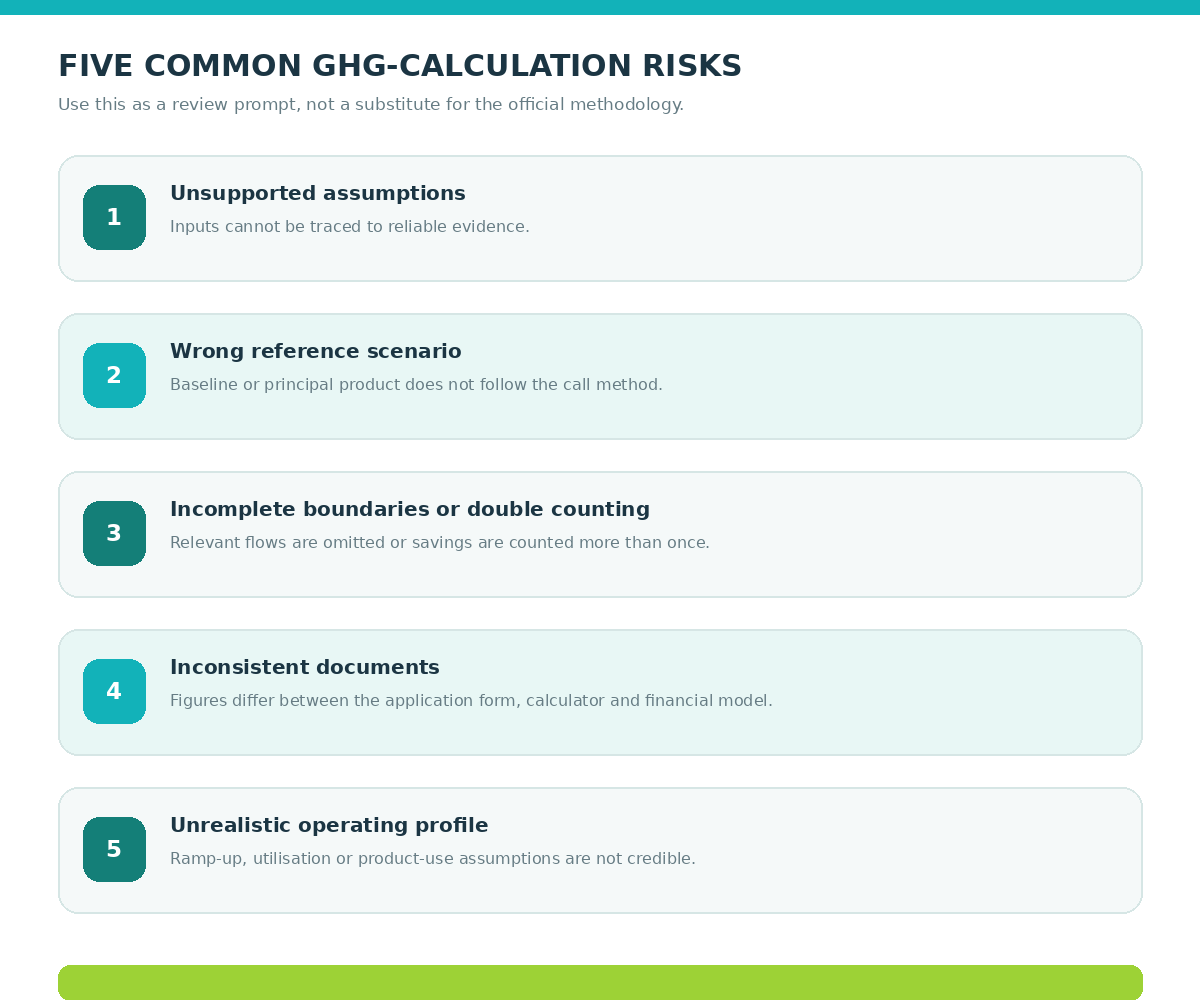
Five common risks in Innovation Fund GHG calculations: unsupported assumptions, an incorrect reference scenario, incomplete boundaries or double counting, inconsistent documents, and unrealistic operating assumptions.
Figure 2. Common risks to check before submission. Source: synthesis of the Commission evaluation, call-specific methodology guidance and ECA audit findings.

9. What the calculation means for scoring and grant disbursement

Calculation quality can affect evaluation scores, and cost efficiency links the grant requested to absolute GHG emissions avoidance under the applicable rules. Call and topic documents specify the relevant formulas, minimum requirements and any thresholds. Do not use a threshold from another call or an older methodology version without checking that it applies.

GHG avoidance is also relevant after award. Article 8 of Commission Delegated Regulation (EU) 2019/856 provides for a reporting period of between three and ten years after entry into operation. If the total emissions avoided over that reporting period is below 75% of the total planned amount, the relevant support paid or payable after financial close is, in principle, proportionally recovered or reduced. The regulation also sets out circumstances in which full recovery may apply and exceptions the Commission may consider in extraordinary circumstances. The grant agreement specifies the contractual recovery grounds and procedures.

This is not a reason to minimise ambition. It is a reason to make the ambition defensible. If a calculation relies on a product use, operating profile or technical performance that cannot later be demonstrated, the project may struggle to substantiate the reductions originally claimed.

LEGAL NOTE

The 75% rule is a specific recovery provision under Article 8, not a general substitute for the grant agreement. Read the regulation and the project’s contractual terms together before drawing conclusions about payment or recovery.

10. Seven practices for a credible GHG calculation

The most useful quality-control steps can be summarised as follows:

  1. Start with the current call text, applicable methodology and required calculator.
  2. Identify the principal product and justify the reference scenario.
  3. Define the system boundary and show relevant process flows.
  4. Trace material inputs to a source, unit, reference period and rationale.
  5. Reflect realistic operating performance, including ramp-up where relevant.
  6. Check for double counting and reconcile the calculator with the application form and financial model.
  7. Design monitoring and reporting around the parameters that underpin the claimed avoidance.
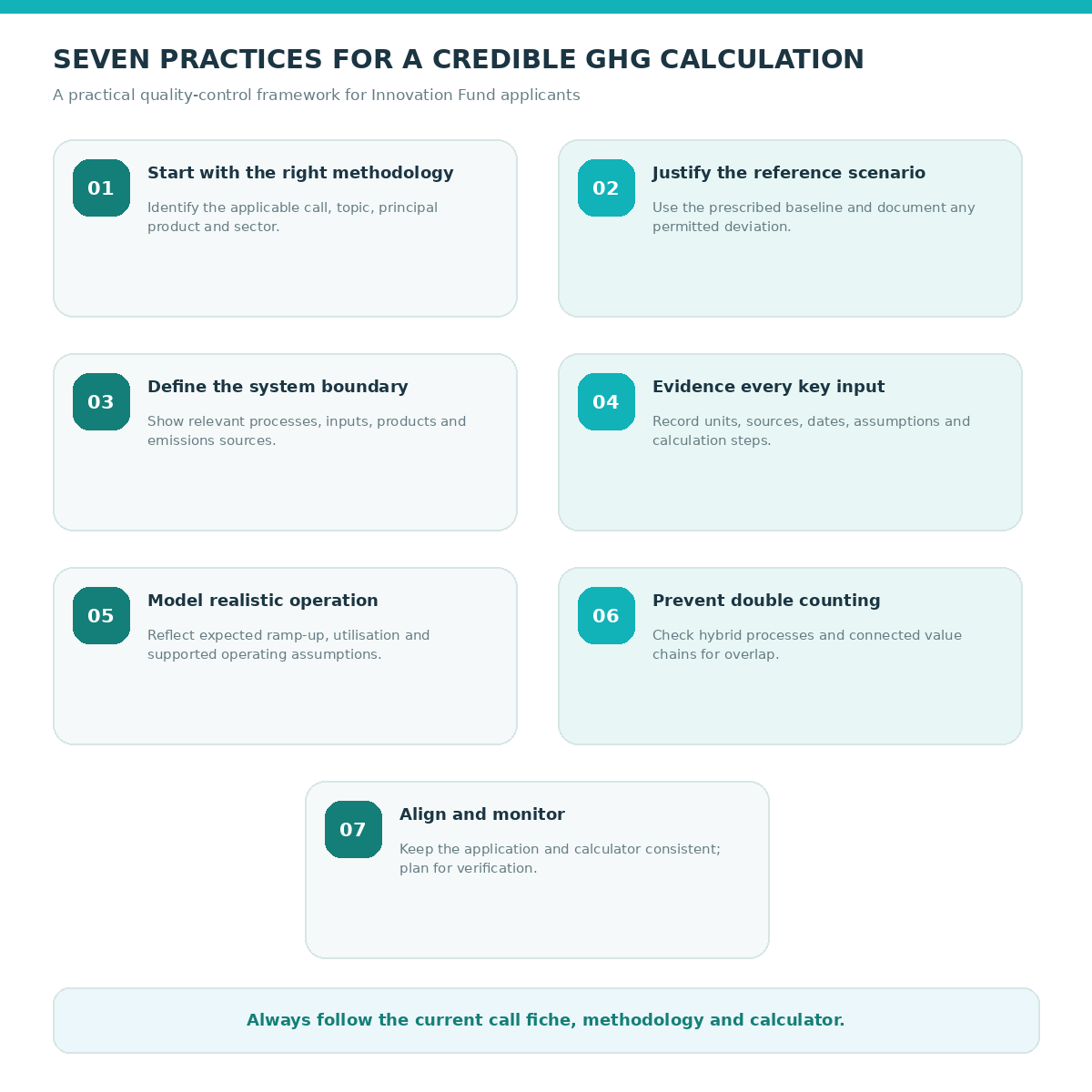
Seven practices for a credible Innovation Fund GHG calculation: correct methodology, justified reference scenario, system boundaries, evidence for inputs, realistic operation, double-counting control and consistency with monitoring.
Figure 3. Seven practical checks for project teams. Always follow the current call-specific methodology and calculator.

How Impact Funding Europe can support your application

A robust GHG calculation requires coordination between the technical design, environmental assumptions, production forecasts and funding application. The numbers should be traceable to supporting evidence and consistent with the broader project case.

Impact Funding Europe supports companies preparing applications for European funding programmes, including the Innovation Fund. Depending on the agreed scope, support can include structuring the funding case, coordinating technical inputs, reviewing consistency across application documents and identifying gaps that need to be addressed by the project team or specialist partners.

For projects with complex industrial processes, hybrid technologies, carbon capture or multi-sector boundaries, clarify early which technical specialists will validate the underlying data and which team members are responsible for the official calculator and supporting documentation.

Preparing an Innovation Fund application? Contact Impact Funding Europe to discuss your project and the requirements that need to be addressed before submission.

Preparing an Innovation Fund application?

Official sources and methodology note

This article is based primarily on the European Commission’s 2026 evaluation of the Innovation Fund’s operation. Technical rules must be checked against the current methodology, calculator and call documents for the specific application. The ECA findings cited below are audit observations about the framework and examples it examined; they should not be treated as permission to depart from the applicable methodology.

Frequently asked questions

Is GHG emissions avoidance the only Innovation Fund award criterion?

No. For regular grant calls it is assessed alongside other criteria, including innovation, project maturity, cost efficiency and replicability. The applicable call document determines the exact criteria, scoring and thresholds.

Can I use the same GHG calculator and threshold as a previous call?

Not without checking. Methodology versions and requirements may differ by call and topic. Use the documents and calculator identified for the application you are preparing.

What happens if verified emissions avoidance is below 75% of planned avoidance?

Article 8 of Delegated Regulation (EU) 2019/856 provides for proportional recovery or reduction of relevant support paid or payable after financial close if total verified avoidance over the reporting period falls below 75% of the planned total, subject to the regulation’s provisions and exceptions. The grant agreement specifies the contractual procedures.

Can a separate LCA replace the Innovation Fund calculator?

Do not treat a separate LCA as a substitute for the calculation required by the call. Use the official methodology and calculator; supporting LCA work may provide evidence for inputs where it is relevant and permitted by the applicable rules.

This article is based primarily on the European Commission’s 2026 evaluation of the Innovation Fund’s operation. Technical rules must be checked against the current methodology, calculator and call documents for the specific application. The ECA findings cited are audit observations about the framework and examples examined; they should not be treated as permission to depart from the applicable methodology. This article is provided for general information only and does not constitute legal advice or a funding guarantee.
↑ Back to top


Innovation Fund Insights · Article 1 of 5

By Yasir Khan · Published 26 October 2026

A practical guide for companies developing innovative low-carbon projects in Europe

The EU Innovation Fund supports the demonstration and deployment of innovative low-carbon technologies that can help decarbonise European industry. But a promising technology alone is not enough to secure support. Applicants need to demonstrate meaningful innovation, credible emissions reductions, convincing project maturity and a realistic pathway to implementation.

The European Commission’s 2026 evaluation of the Fund’s operation offers an evidence-based view of how the programme has performed and where applicants continue to face challenges. Its portfolio data largely cover the period up to the first quarter of 2025, so the figures below should be read as a snapshot of the Fund’s early implementation – not as a statement of current call status.

Programme fundingThe Innovation Fund is financed by EU ETS allowance revenues; the ECA describes an estimated envelope of around €40 billion for 2020–2030.
Portfolio at end March 2025208 projects had been awarded grants; 192 remained ongoing, with €11.6 billion in committed support.
Expected climate impactThe 192 ongoing projects were expected to avoid 871 million tonnes of CO₂-equivalent emissions over their first decade of operation.
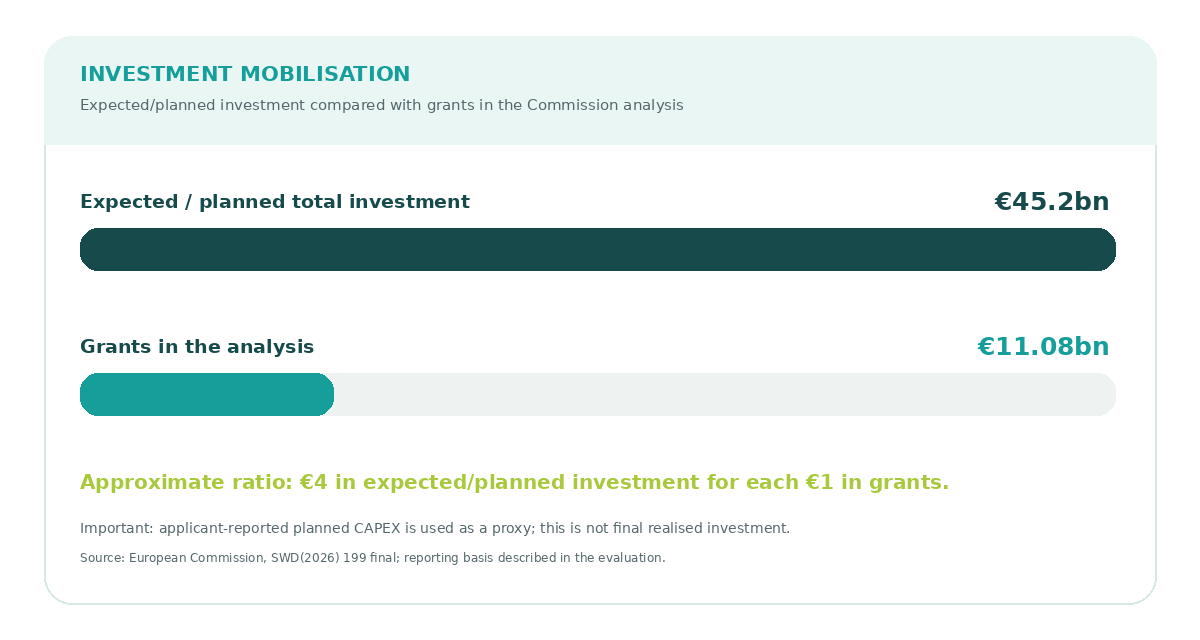
Investment mobilisationThe Commission’s analysis reported €45.2 billion in expected/planned total investment against €11.08 billion in grants; planned CAPEX was used as a proxy.

Source reports: European Commission evaluation (SWD(2026) 199 final) | European Court of Auditors Special Report 11/2026

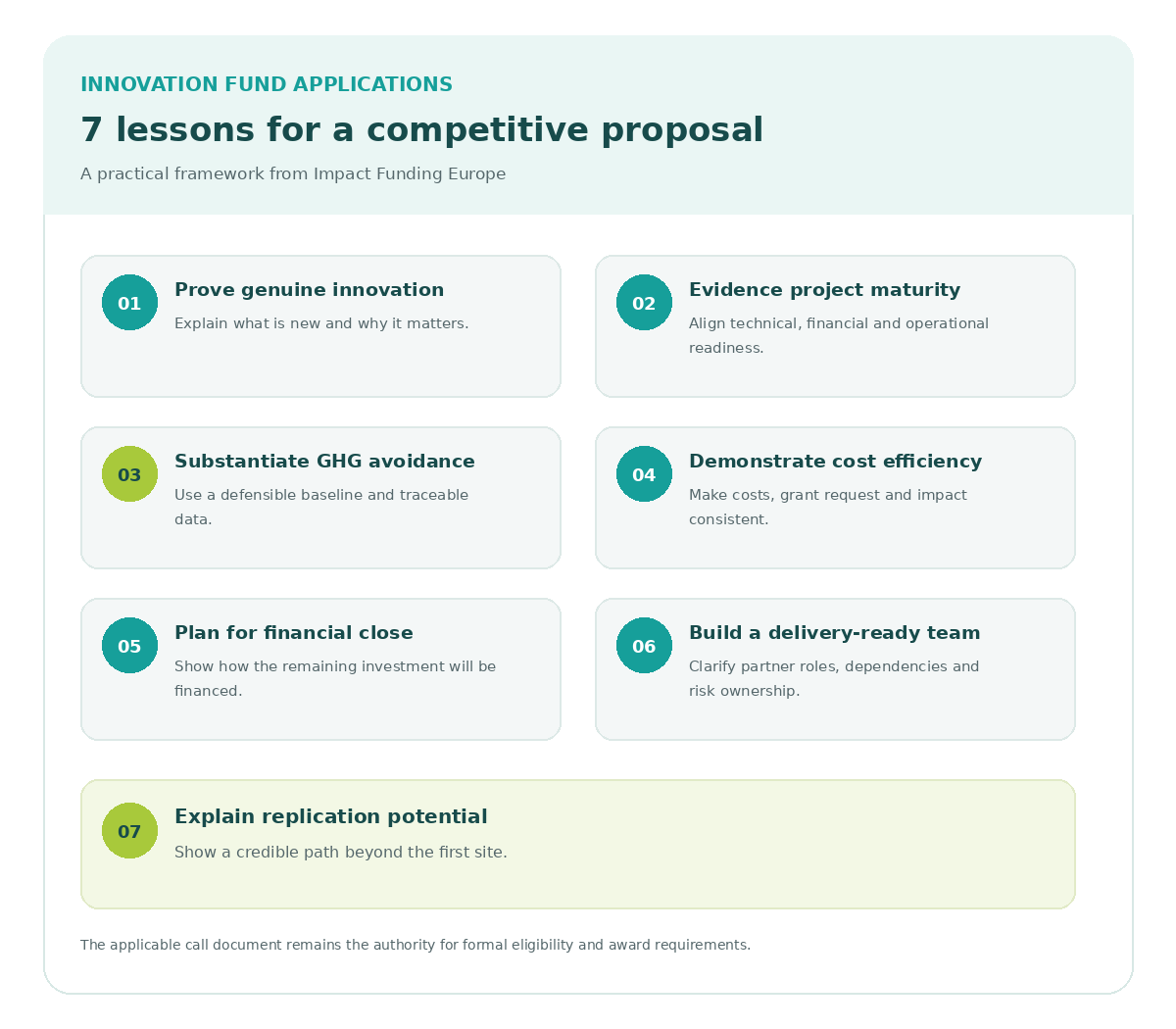
For organisations preparing an Innovation Fund application, the report points to seven practical lessons.

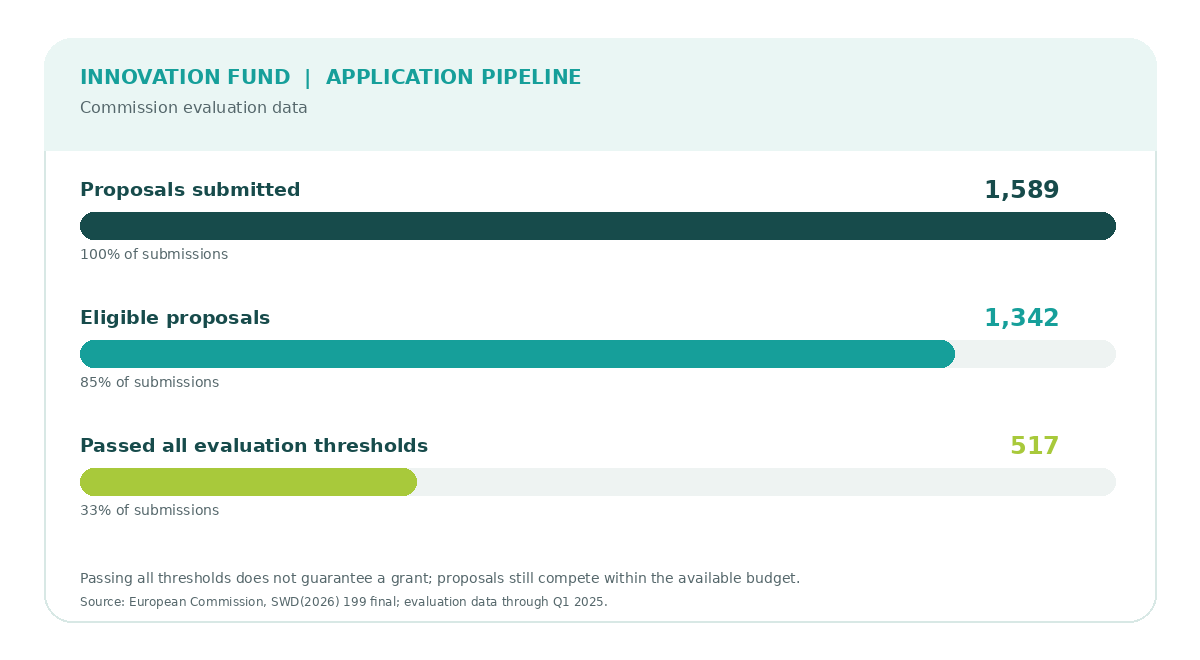
Of 1,589 submitted proposals, 1,342 were eligible and 517 passed all evaluation thresholds.
Commission evaluation data on submitted, eligible and above-threshold proposals; evaluation data through Q1 2025. Passing thresholds does not guarantee funding.

1. Demonstrate genuine innovation – and explain the role of public support

The Innovation Fund is not a general decarbonisation grant. It is designed to support innovative technologies, processes, products and solutions with significant potential to reduce greenhouse gas emissions. The evaluation identifies the degree of innovation as a core element of the regular-grant assessment and notes that projects similar to previously funded solutions must explain what is new about their own proposal.

Applicants should establish a clear baseline against which their technology can be assessed. Explain what is technically or commercially new, how the proposed solution differs from the current state of the art, and why the innovation matters for the relevant industrial process or market.

The funding rationale should also be credible. Although “additionality” should not be presented as a standalone award criterion unless the applicable call says so, the project narrative and financial plan should clearly explain the funding need, the investment barriers and the role Innovation Fund support is expected to play in enabling or accelerating deployment.

Where comparable technologies have already received support, avoid relying on broad claims such as “first of its kind” or “revolutionary” without evidence. Identify the specific differentiators – such as scale, application, performance, process integration or deployment conditions – and substantiate them.

IFE insight

A clear innovation case moves beyond describing the technology. It explains what changes compared with existing solutions, why that change matters and how the project supports credible industrial decarbonisation.

2. Match project maturity to the right call

The Commission evaluates project maturity across technical, financial and operational dimensions. Technical maturity concerns the feasibility of the expected outputs, knowledge of technical risks and proposed mitigation measures. Financial maturity concerns the credibility of the business model and financing plan, including the ability to reach financial close within the applicable timeframe. Operational maturity looks at the implementation plan, the project team and the status of permits, licences and regulatory procedures.

These dimensions must reinforce one another. A technically promising project can still appear unready if critical permits are missing, the delivery schedule is unrealistic or the financing plan relies on unsupported assumptions. Applicants should assemble evidence proportionate to the project and the chosen call, including engineering studies, risk registers, implementation schedules, financing plans and a realistic account of outstanding approvals.

Call choice matters, too. Project size, technology area, readiness and the specific topic all affect which call or funding route is appropriate. Do not assume that a project eligible for one Innovation Fund call will automatically fit another. Review the current call fiche and its definitions, eligibility rules, award criteria, cost methodology and submission requirements before building the application around them.

The Commission also found that tailored Project Development Assistance (PDA) has helped some initially unsuccessful proposals address maturity gaps. By 2024, 16 of the 37 PDA beneficiaries who reapplied had secured an Innovation Fund grant – a 43% success rate among those reapplicants. This is not a general success-rate forecast: PDA recipients were selected from among promising proposals, and the Commission cautions against treating the result as a causal comparison.

Practical check

Can the project team show where the project stands today, what remains to be completed, who owns each action and how the remaining work fits the grant and financial-close timetable?

3. Build a greenhouse gas calculation that stands up to scrutiny

Greenhouse gas (GHG) emissions avoidance is central to the Innovation Fund. A weak calculation can undermine the credibility of an otherwise promising project. The Commission’s evaluation highlights three aspects of the assessment: absolute emissions avoidance, relative emissions avoidance and the quality of the calculation.

Applicants should identify and justify the reference scenario, define the relevant system boundaries and use traceable, defensible data. Assumptions about production volumes, energy consumption, feedstock use, emissions intensity and operating performance should be aligned with the technical design and financial model, where relevant. Any material uncertainty should be treated transparently rather than hidden inside optimistic assumptions.

A large headline figure for tonnes of CO₂ avoided is not sufficient by itself. Evaluators need to understand how the result was calculated and why the baseline is appropriate. GHG calculations should therefore be developed in parallel with the technical and financial case – not treated as a formality to finish at the end of the application.

The legal framework also links part of the grant support paid after financial close to verified emissions avoidance during the reporting period. Under Article 8 of Delegated Regulation (EU) 2019/856, where total verified emissions avoidance over that period is below 75% of the planned total, the relevant amount paid or payable after financial close is proportionally reduced or recovered, subject to the regulation’s provisions and exceptions. Exact obligations should be checked against the regulation and the project’s grant agreement.

IFE insight

An emissions calculation should be traceable from source data to final result. Align the reference scenario, technical assumptions and financial model, and verify all call-specific methodological requirements before submission.

Seven lessons: innovation, project maturity, GHG avoidance, cost efficiency, financial close, delivery-ready team and replicability.
Figure 2. Seven practical lessons for preparing an Innovation Fund application.

4. Demonstrate cost efficiency and value for money

The regular-grant assessment considers cost efficiency in relation to the grant requested and the project’s absolute GHG emissions avoidance. Applicants should make sure that the requested support, eligible or relevant costs, emissions calculations and financial assumptions are consistent with the methodology set out in the call.

A strong financial case needs more than a large project budget or a high emissions-reduction claim. It should use credible cost estimates, clearly explain the assumptions and show how the requested support relates to the project’s expected climate benefits. Errors or incomplete calculations can weaken an application even when the technology is attractive.

For most topics, the Commission’s evaluation says cost-efficiency ratios above €200 per tonne of CO₂-equivalent lead to rejection, but thresholds differ for some topics, including pilots. Treat this as call-specific: check the relevant call fiche and scoring formula, especially where future call terms have not yet been published.

Similarly, regular Innovation Fund grants can cover up to 60% of relevant costs under the applicable methodology and conditions. This is not a promise to cover 60% of every project’s total capital expenditure. Applicants need a clear view of which costs are relevant and eligible, what the grant can cover and how the remaining investment will be financed.

The Commission’s investment-mobilisation analysis reported around €45.2 billion in total expected or planned investment against €11.08 billion in grants, a ratio of roughly four to one. This was based on applicant-reported planned capital expenditure as a proxy. It should not be represented as a final audited measure of investment realised by all projects.

Comparison of €45.2 billion in expected or planned investment with €11.08 billion in grants.
The Commission reported €45.2 billion in expected/planned total investment against €11.08 billion in grants in its investment-mobilisation analysis; applicant-reported planned CAPEX is used as a proxy.

Preparing an Innovation Fund application and want a second pair of eyes?

5. Plan for financial close from day one

Winning a grant is not the same as delivering a project. The Commission’s evaluation identifies financing gaps and changing market conditions among the principal causes of project delays and withdrawals. Difficulties raising capital, cost increases and an inability to secure offtake agreements can all affect project viability.

Applicants should develop a financing strategy that goes beyond the amount requested from the Innovation Fund. It should explain the total investment required, the expected grant contribution, other sources of finance, the status of financing discussions and the assumptions that underpin projected revenues and operating costs. Any material dependencies should be identified clearly.

Financial close also depends on delivery readiness. The project plan should identify the permits, licences, construction arrangements, partner commitments and commercial agreements that remain outstanding, together with realistic timelines and mitigation measures. For projects that rely on future infrastructure – such as grid connections, hydrogen pipelines or CO₂ transport and storage – explain the dependency and the status of the relevant arrangements.

The European Court of Auditors’ 2026 audit provides a separate warning about implementation risk. It found that, by 30 June 2025, 40 of 228 projects initially selected for support had been cancelled or withdrawn: 20 before grant agreements were signed and 20 after signature. This is a different measure from the Commission evaluation’s count of terminated signed projects. It nevertheless reinforces the importance of realistic maturity assessments and financing plans.

Practical check

For every major financing, permitting, infrastructure or offtake dependency, record its current status, the accountable party, the expected completion date and the consequence if it is delayed.

6. Show that the delivery team and value chain can execute the project

Project maturity is not only a matter of technology and spreadsheets. It also depends on whether the organisation or partnership responsible for delivery has the capabilities, governance and commitments needed to bring the project into operation.

Where a project relies on multiple partners, the application should make the division of responsibilities clear. Technical providers, industrial hosts, engineering and construction partners, feedstock or energy suppliers, offtakers, infrastructure operators and financing partners may all be important, depending on the project. Their roles should be credible and reflected in the implementation schedule and risk plan.

A consortium is not a formal requirement for every Innovation Fund project. The principle is to demonstrate that the proposed delivery structure is appropriate to the project’s complexity and that essential capabilities are covered. Unclear responsibilities, dependence on a single key partner or assumptions about unconfirmed commercial relationships can create avoidable weaknesses.

The project should also explain how it fits into the wider value chain. For industrial decarbonisation, this may include access to reliable low-carbon energy, transport and storage infrastructure, sustainable inputs, customers for the resulting product and the relevant permitting framework. These elements help connect the proposal’s technical ambition to its real-world implementation conditions.

7. Explain how the project can be replicated and scaled

The Innovation Fund is designed to support projects with the potential to contribute to broader decarbonisation, not just deliver a single successful installation. Replicability is therefore a core part of the regular-grant assessment.

A strong proposal should explain where and how the technology could be deployed beyond the first site, what future efficiency or environmental gains may be possible, and which conditions would enable replication. Depending on the project, these might include standardised equipment, lessons from demonstration, cost reductions, compatible infrastructure, transferable operating practices or the development of a stronger European supply chain.

The case should remain realistic. Distinguish what the initial project will demonstrate from what might be achieved at additional sites or at larger scale. Set out assumptions, prerequisites and potential barriers. Avoid unsupported claims about the number of future installations, market share or emissions savings that the project itself will not directly deliver.

The Commission’s evaluation reports that the 192 ongoing projects were expected to avoid 871 million tonnes of CO₂-equivalent emissions over their first decade of operation. This is a portfolio-level projection, not a realised emissions outcome, and it does not automatically measure the wider replication impact of each project. The role of an applicant is to present a credible project-specific case for how its innovation can support wider deployment.

What these lessons mean for prospective applicants

The Commission’s evaluation shows that a competitive Innovation Fund application requires consistency across the technical, environmental, financial and operational case. The technology must be genuinely innovative, the emissions calculation must be defensible, the cost-efficiency case must follow the applicable methodology, and the financing and implementation plan must stand up to scrutiny.

The evaluation’s proposal data also underline the competitive nature of the programme. Across the proposals covered by its summary, 1,589 were submitted, 1,342 were eligible and 517 passed all evaluation thresholds. Passing thresholds does not necessarily guarantee funding: proposals also compete within the available budget, and high-quality proposals can remain unfunded when demand exceeds resources.

A practical preparation process should therefore begin well before submission. Confirm the right call, test the project’s maturity, align the technical and financial models, verify the GHG methodology and identify the evidence needed to support every significant claim. The current call documentation remains the controlling source for eligibility, scoring and submission requirements.

Looking ahead: IF26 calls (time-sensitive)

As of 15 October 2026, the European Commission’s calls page states that five IF26 calls are planned to open in December 2026: Net-Zero Technologies, SME, Maritime, Heat Auction and Hydrogen Auction. The planned SME call has a €200 million budget and is intended for SME projects with €2.5 million–€20 million in capital expenditure, with two application rounds indicated. Dates and conditions are indicative until confirmed in the published call documents. Check the live Commission pages before relying on these details.

How Impact Funding Europe can support your Innovation Fund application

Preparing an Innovation Fund application requires technical, environmental, financial and commercial information to support one coherent case for funding. Impact Funding Europe provides EU grant-writing and funding support for organisations developing smart, digital and climate-neutral projects, including proposal writing, consortium building, fund matching and project administration.

For a prospective applicant, an early discussion can help identify the relevant funding route, clarify the work needed to prepare a competitive proposal and surface gaps in the project’s technical, financial or operational case.

Considering an Innovation Fund application?

Contact Impact Funding Europe to discuss your project and the appropriate next steps.

This article reflects the European Commission’s 2026 evaluation of the Innovation Fund’s operation and portfolio data up to the first quarter of 2025. Figures are a snapshot of the Fund’s early implementation and not a statement of current call status. Call dates and conditions are indicative until confirmed in the published call documents; check the live Commission pages before relying on these details.

↑ Back to top


Leaf l green.png

Clean Energy

In 2019 the EU completed a comprehensive update of its energy policy framework to facilitate the transition away from fossil fuels towards cleaner energy and to deliver on the EU’s Paris Agreement commitments for reducing greenhouse gas emissions.

The agreement on this new energy rulebook – called the Clean energy for all Europeans package – marked a significant step towards the implementation of the energy union strategy, published in 2015.

Climate, Energy and Mobility is the focus for Cluster 5 in Horizon Europe. This clusters aims to fight climate change by better understanding its causes, evolution, risks, impacts and opportunities, and by making the energy and transport sectors more climate and environment-friendly, more efficient and competitive, smarter, safer and more resilient

More information here.

Recent Projects

Mortiz Thiede

Dr. Mortiz Thiede

Financial Modelling & Loan Facilities

Dr. Moritz Thiede strengthens Impact Funding Europe’s finance work with robust modelling and debt-structuring expertise. Trained as an economist (Diplom-Volkswirt), he has served as a Senior Consultant delivering complex company analyses, controlling systems, restructuring support, and financing advisory.

He builds bankable financial models, develops scenarios that survive stress tests, and translates project narratives into lender-ready numbers—cashflow logic, covenants, and repayment capacity. Moritz supports clients in structuring loan facilities, negotiating term sheets, and aligning funding strategy with operational reality, including blended finance approaches where grants and debt must fit together cleanly. He works comfortably with lenders and investors alike.

Olaf Gerd Gemein

Olaf Gerd Gemein

Verocity

Olaf is a passionate Serial Entrepreneur and Business Architect with a specific ambition: to be a change catalyst!

With over 30 years of practical experience in various markets in Europe, Asia, North and South America and Canada, he has successfully supported more than 100 projects in the ICT sector. His contributions have focused on accelerating start-up and innovation clusters, building networks, products and services from scratch, facilitating and implementing go-to-market strategies. He is frequently asked to speak at conferences and facilitate networking on smart tech topics around the world.

Peter Schottes

Peter Schottes

Eisenschmidt Consulting

Peter holds a PhD in nature science (climate impact research), worked as a project manager for software development and as a freelance consultant. He is managing director and shareholder of Eisenschmidt Consulting Crew in Kiel, Germany. He is a specialist in transformation projects and works as a sparring partner for top executives. His focus in on strategy development, digital transformation and concept development.

Peter is active as advisor for StartUps and Angel investor. At IFE he overlooks the entire process of community building, stakeholder management and is also responsible for the project kick-offs.

Alex neu

Alex Chalkley

Venturenomix

Alex has a BSc in Mathematics, Economics & Computing and has already built a market-leading R&D Funding Consultancy in the UK from 2009 to 2019. Alex has developed funding bids, mainly in the form of R&D Grant Applications, that have secured over €60m for clients operating at the forefront of technology innovation. Venturenomix, focuses on supporting Impact Ventures by offering specialist funding related consultancy services to ambitious people seeking funding for good projects. At IFE, Alex is Managing Director and responsible for all aspects of the business, in particular recruiting, mentoring and adding value to the EU Grant Writing Consultants working on multi-million Euro EU Grant Applications.

Smart city l green

Smart City

A smart city is a place where traditional networks and services are made more efficient with the use of digital and telecommunication technologies for the benefit of its inhabitants and business. 

A smart city goes beyond the use of information and communication technologies (ICT) for better resource use and less emissions. It means smarter urban transport networks, upgraded water supply and waste disposal facilities and more efficient ways to light and heat buildings. It also means a more interactive and responsive city administration, safer public spaces and meeting the needs of an ageing population. Last not least, it aims to make a city a healthier, more sustainable and more attractive place to be for its residents and visitors.

More than half of the world’s population now lives in urban areas. This is expected to reach 80% by 2050. Cities and metropolitan areas are centres of economic activity, knowledge generation, innovation and new technologies. Cities influence the quality of life of citizens who live or work in them and they are major contributors to global challenges.

A mission in this area will help us meet the goals and targets set out by international policy frameworks such as the COP21 Paris Agreement, the UN’s Sustainable Development Goals (notably SDG11), the Urban Agenda for the EU and the Habitat III New Urban Agenda as cities play a key role in all of them.

Read more here.

Recent Projects

Green city l green

Green Deal

The European Green Deal sets out how to make Europe the first climate-neutral continent by 2050. It maps a new, sustainable and inclusive growth strategy to boost the economy, improve people’s health and quality of life, care for nature, and leave no one behind.

The Green Deal spans and informs all of the Horizon Europe Pillars and Destinations. As such, there is no dedicated funding programme, apart from Horizon Europe itself. This strategy underpins Horizon Europe funding from 2021-2027. You can read more about the Pillars and funding opportunities here.

Recent Projects

Laptop l green

Open Data

The success of Europe’s digital transformation will depend on establishing effective rules to ensure trustworthy technologies, to give businesses the confidence and means to digitise, and to ensure highest privacy standards for citizens. The Data Strategy and the White Paper on Artificial Intelligence are the first pillars of the new digital strategy of the Commission. They all focus on the need to put people first in developing technology, as well as on the need to defend and promote European values and rights in how we design, make and deploy technology in the economy.

The European strategy for data aims at creating a single market for data that will ensure Europe’s global competitiveness and data sovereignty. Common European data spaces will ensure that more data becomes available for use in the economy and society, while keeping companies and individuals who generate the data in control.

Cluster 4 in Horizon Europe is dedicated to Digital, Industry and Space. The overarching vision behind the proposed investments under Cluster 4 is that of Europe shaping competitive and trusted technologies for a European industry with global leadership in key areas, enabling production and consumption to respect the boundaries of our planet, and maximising the benefits for all parts of society in the variety of social, economic and territorial contexts in Europe.

This will build a competitive, digital, low-carbon and circular industry, ensure sustainable supply of raw materials, develop advanced materials and provide the basis for advances and innovation in  global challenges to society.

Recent Projects

Electric car l green

Mobility

The European Green Deal calls for a 90% reduction in greenhouse gas emissions from transport in order for the EU to become a climate-neutral economy by 2050, while also working towards a zero-pollution ambition. To achieve this systemic change, we need to (1) make all transport modes more sustainable, (2) make sustainable alternatives widely available in a multimodal transport system and (3) put in place the right incentives to drive the transition.

Climate, Energy and Mobility is the focus for Cluster 5 in Horizon Europe. This clusters aims to fight climate change by better understanding its causes, evolution, risks, impacts and opportunities, and by making the energy and transport sectors more climate and environment-friendly, more efficient and competitive, smarter, safer and more resilient

More information here.

Recent Projects

Leaf l green

Agriculture

The Farm to Fork Strategy is at the heart of the Green Deal. It addresses comprehensively the challenges of sustainable food systems and recognises the inextricable links between healthy people, healthy societies and a healthy planet. The strategy is also central to the Commission’s agenda to achieve the United Nations’ Sustainable Development Goals (SDGs). All citizens and operators across value chains, in the EU and elsewhere, should benefit from a just transition, especially in the aftermath of the COVID-19 pandemic and the economic downturn. A shift to a sustainable food system can bring environmental, health and social benefits, offer economic gains and ensure that the recovery from the crisis puts us onto a sustainable path. Ensuring a sustainable livelihood for primary producers, who still lag behind in terms of income, is essential for the success of the recovery and the transition.

Cluster 6 under Horizon Europe ringfences innovation grant funding for Food, Bioeconomy, Natural Resouces, Agriculture & Environment. This cluster aims at reducing environmental degradation, halting and reversing the decline of biodiversity on land, inland waters and sea and better managing natural resources through transformative changes of the economy and society in both urban and rural areas. It will ensure food and nutrition security for all within planetary boundaries through knowledge, innovation and digitalisation in agriculture, fisheries, aquaculture and food systems and steer and accelerate the transition to a low carbon, resource efficient circular economy and sustainable bioeconomy, including forestry.

More information here.

Recent Projects