By Yasir Khan · Published 16 November 2026
For companies preparing an Innovation Fund application, greenhouse gas (GHG) emissions avoidance is a central part of the climate and technical case for funding. Applicants need to show how a project compares with an appropriate reference scenario, substantiate the assumptions behind the calculation and demonstrate that the expected reductions are credible under realistic operating conditions.
The European Commission’s 2026 evaluation identifies GHG calculation quality as an important part of proposal assessment. It notes that unrealistic or poorly substantiated emissions claims can lead to lower evaluation scores. It also cautions that, because many supported projects remain at early implementation stages, there is not yet enough evidence to assess conclusively how accurately application-stage calculations predict the emissions reductions ultimately delivered.
The European Court of Auditors (ECA) has also raised concerns about aspects of the sector-specific methodology it examined, including cases where the treatment of certain activities could overstate avoided emissions. These findings make methodological discipline important not only at submission, but also during monitoring and verification.
The practical message is straightforward: a credible GHG calculation is not necessarily the calculation with the largest headline reduction. It is the calculation that follows the applicable methodology, uses a justified reference scenario, documents its assumptions and can be checked against evidence.
KEY TAKEAWAY
Treat the GHG calculation as part of the project design and monitoring plan – not as a spreadsheet completed at the end of the application.
1. Understand what the GHG assessment measures
For regular Innovation Fund grant calls, GHG emissions avoidance is assessed alongside other criteria such as innovation, project maturity, replicability and cost efficiency. It is important, but it is not the only determinant of whether a proposal is selected. The precise criteria, score weights, thresholds and eligibility conditions are set out in the applicable call documentation.
The Commission’s methodology distinguishes three elements in the GHG assessment:
- Absolute GHG emissions avoidance: the total expected reduction compared with the reference scenario over the prescribed assessment period, expressed in tonnes of CO₂ equivalent (tCO₂e).
- Relative GHG emissions avoidance: the reduction expressed in relation to emissions in the reference scenario.
- Quality of calculation: whether the method, assumptions, supporting evidence and calculations comply with the applicable rules and are presented in a robust, traceable way.
These measures answer different questions. Absolute avoidance indicates the scale of the expected climate benefit; relative avoidance expresses the reduction against the baseline; calculation quality addresses whether the resulting claim can be relied upon. Cost efficiency also depends on absolute emissions avoidance under the applicable methodology, so inputs must be consistent across the calculation and the rest of the application.
The relevant call fiche determines the scoring formula and any minimum thresholds. Applicants should not transfer a threshold from an older call or a different topic without checking that it applies to their submission.
2. Start with the correct call methodology and project scope
Before entering data, establish exactly what the proposed project will do, which product or service is the principal output, and which sector-specific methodology applies. Industrial projects often combine several processes, products or technologies. A project may, for example, manufacture a component and use it in an energy-generation process, or combine production with carbon capture and utilisation.
The applicable methodology may treat different sectors and activities differently. Applicants should therefore begin with the call text, the current GHG methodology and the required calculator. The European Climate, Infrastructure and Environment Executive Agency (CINEA) maintains the official Tools and Guidance page, which provides access to the current methodology and sector-specific examples.
The IF25 Net-Zero Technologies methodology is a useful published example of the approach, but it should not be treated as a universal rulebook for all calls. For every submission, confirm the methodology version, calculator and topic-specific provisions attached to the relevant call.
3. Establish and justify the reference scenario
The reference scenario represents the emissions expected in the absence of the proposed project, under the definitions and conditions set by the applicable methodology. The project scenario is assessed against that reference to calculate the emissions avoided.
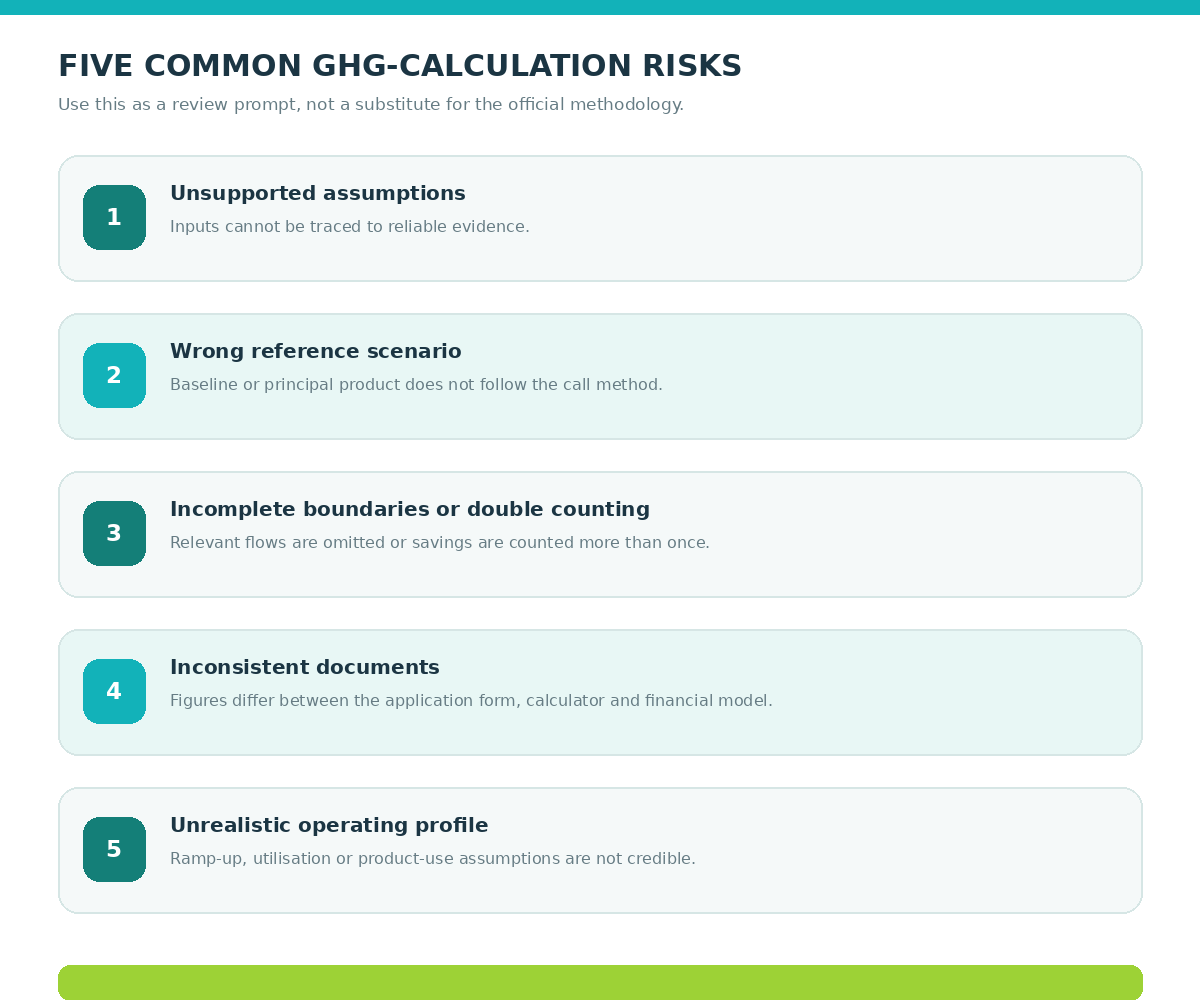
The baseline is not a blank canvas. Depending on the sector and product, the methodology may prescribe a reference product, process, emission factor or calculation approach. Applicants should not choose a reference scenario simply because it produces a larger reduction. They should identify the principal product, use the appropriate sector section and document any deviation only where the applicable rules permit it.
A weak or incorrectly selected reference scenario can undermine the result even if the proposed technology is genuinely innovative. A baseline that assumes an unnecessarily emissions-intensive conventional alternative, for example, may exaggerate the apparent improvement. Conversely, an incorrect baseline may understate a legitimate benefit.
The application should explain why the reference scenario is appropriate and preserve supporting evidence for the inputs used. Reviewers should be able to understand what would happen without the project and how that case is consistent with the relevant methodology.
4. Define system boundaries and avoid double counting
The system boundary determines which processes, inputs, products and emissions are included in the comparison. Depending on the project and methodology, relevant elements may include the production process, electricity and heat, fuels, raw materials, direct process emissions, product use, transport or eligible carbon-capture credits.
Applicants should not automatically include or exclude an emissions source based on general life-cycle assessment practice. The Innovation Fund’s prescribed method takes precedence. For the applicable sector, identify the required inputs, outputs, subprocesses and system boundaries, and make sure the project and reference scenarios are treated consistently.
Double counting is a particular risk when a project spans connected activities or value chains. The same emissions saving should not be credited twice. For example, where more than one funded activity relates to the manufacture and use of the same technology, applicants need to examine the applicable sector methodology carefully and avoid overlapping claims.
The ECA’s audit highlighted potential overstatement in particular methodological treatments, including energy-storage calculations based on a device being sold rather than its actual use, and possible overlap when both solar-panel manufacturing and solar-power generation using those panels receive support. These are findings about the framework the ECA examined. They do not give applicants permission to change an official formula ad hoc; they reinforce the need to use the current call methodology and to make assumptions and system boundaries transparent.
PRACTICAL IMPLICATION
For hybrid or multi-sector projects, create a simple process-flow diagram and a boundary checklist. Show which emissions and savings are counted in each calculation, and document how overlap is prevented.
5. Substantiate every material input and assumption
A calculation is only as credible as the data and assumptions behind it. Production volumes, operating hours, capacity utilisation, energy consumption, process efficiency, feedstock use, product yields and emissions factors can all materially affect the result, depending on the sector.
For each important input, record its value, unit, source, reference period, calculation method and rationale. Make clear whether the value is measured, calculated from another parameter, taken from the prescribed methodology or based on a project assumption. Where an assumption is uncertain, explain why the selected value is reasonable and what evidence supports it.
Useful supporting evidence can include engineering studies, equipment specifications, pilot or test data, energy and material balances, supplier information, production forecasts, recognised emission factors and commercial documentation. The appropriate evidence depends on the parameter and the requirements of the relevant call.
Be particularly careful with design performance versus demonstrated performance. A technology’s nameplate efficiency or theoretical output may not reflect the operating profile of a new industrial facility. Assumptions about access to low-carbon electricity, feedstocks or product markets should be aligned with the project’s technical design and evidence of availability.
6. Model realistic operation, including ramp-up
The calculation should reflect how the project is expected to operate – not simply its best-case design performance. New industrial facilities may experience commissioning periods, process adjustments, planned shutdowns or lower performance in the early years. Where the methodology requires expected ramp-up effects to be reflected, the model should account for them explicitly.
The GHG calculation should also align with the project’s production schedule and financial model. If the business plan assumes a gradual increase in output, the emissions model should not silently assume full production from day one. Likewise, operating hours, product mix, energy use and feedstock assumptions should remain consistent across all relevant documents.
For the ten-year assessment approach used in the published IF25 NZT methodology, annual assumptions matter because an operating profile that changes over time may produce a different total than multiplying one steady-state annual value by ten. The applicable methodology determines the actual assessment period, calculation rules and treatment of any eligible credits.
7. Calculate absolute and relative avoidance transparently
Once the reference scenario, project scenario and system boundaries have been established, calculate the emissions in each scenario using the prescribed methodology. Absolute avoidance is the difference between reference and project emissions, subject to the specific treatment of eligible credits and other provisions in the applicable methodology. Relative avoidance expresses the reduction relative to the reference scenario.
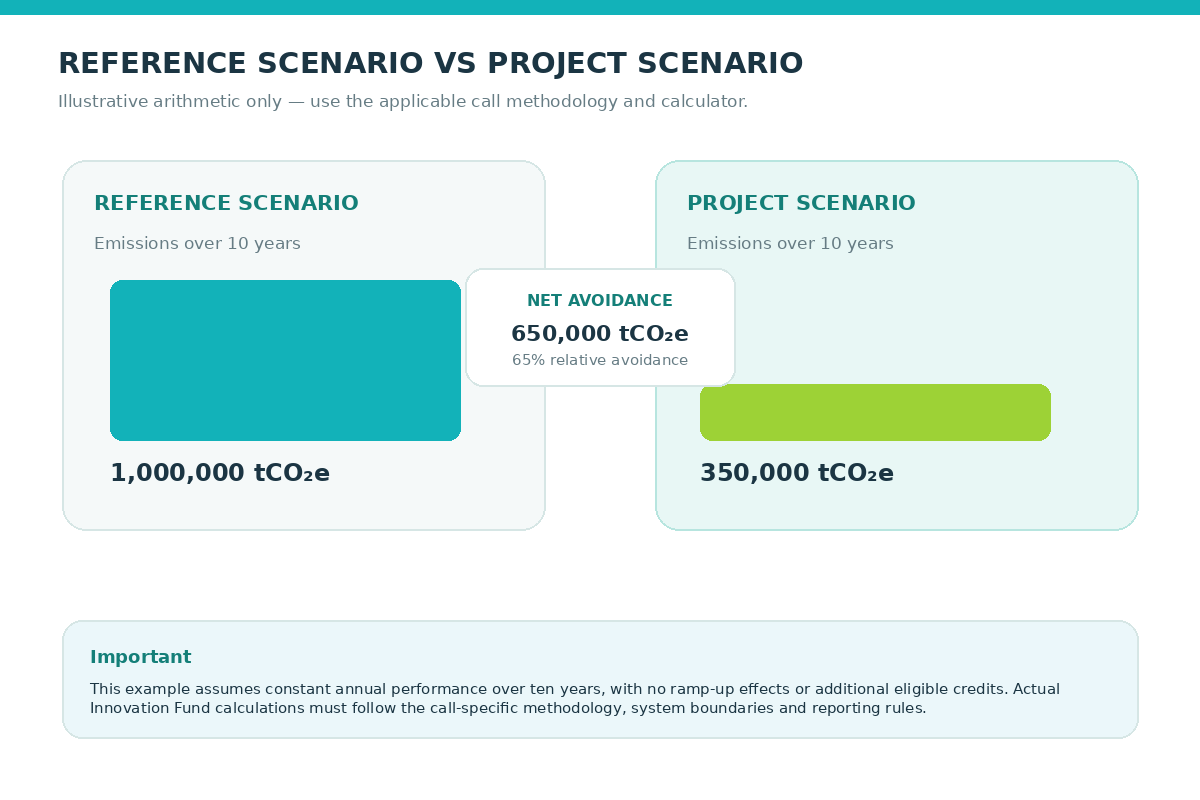
A simplified illustration helps distinguish the two metrics. Assume the reference scenario emits 100,000 tCO₂e annually and the project scenario emits 35,000 tCO₂e annually. If those figures were unchanged for ten full years, and there were no ramp-up effects or additional credits, the reference total would be 1,000,000 tCO₂e and the project total would be 350,000 tCO₂e. Absolute avoidance would be 650,000 tCO₂e and relative avoidance would be 65%.
This is only the arithmetic of a simplified example. It is not an official calculator result and does not reproduce every rule in the Innovation Fund methodology. A real application must apply the correct emission factors, sector rules, time profile, operating assumptions and credits, as relevant to the project.
8. Keep the calculator, application form and project model consistent
A calculation can be technically sound yet difficult to assess if key figures differ across the application form, GHG calculator, technical description, cost-efficiency calculation and financial model. Production volumes, operating hours, product flows, energy use and absolute or relative avoidance figures should reconcile wherever the same assumptions are used.
Use the official calculator and forms required by the call. Keep formulas and source cells easy to follow, complete any data-traceability fields, and provide supporting explanations where requested. A separate life-cycle assessment (LCA) may be useful supporting evidence where relevant, but it should not replace the prescribed Innovation Fund calculation unless the applicable call documentation explicitly provides otherwise.
A final quality-control pass should compare the headline values in the application form with the calculator outputs and identify the exact source of any material input. This also makes it easier to update the model if assumptions change during implementation.
9. What the calculation means for scoring and grant disbursement
Calculation quality can affect evaluation scores, and cost efficiency links the grant requested to absolute GHG emissions avoidance under the applicable rules. Call and topic documents specify the relevant formulas, minimum requirements and any thresholds. Do not use a threshold from another call or an older methodology version without checking that it applies.
GHG avoidance is also relevant after award. Article 8 of Commission Delegated Regulation (EU) 2019/856 provides for a reporting period of between three and ten years after entry into operation. If the total emissions avoided over that reporting period is below 75% of the total planned amount, the relevant support paid or payable after financial close is, in principle, proportionally recovered or reduced. The regulation also sets out circumstances in which full recovery may apply and exceptions the Commission may consider in extraordinary circumstances. The grant agreement specifies the contractual recovery grounds and procedures.
This is not a reason to minimise ambition. It is a reason to make the ambition defensible. If a calculation relies on a product use, operating profile or technical performance that cannot later be demonstrated, the project may struggle to substantiate the reductions originally claimed.
LEGAL NOTE
The 75% rule is a specific recovery provision under Article 8, not a general substitute for the grant agreement. Read the regulation and the project’s contractual terms together before drawing conclusions about payment or recovery.
10. Seven practices for a credible GHG calculation
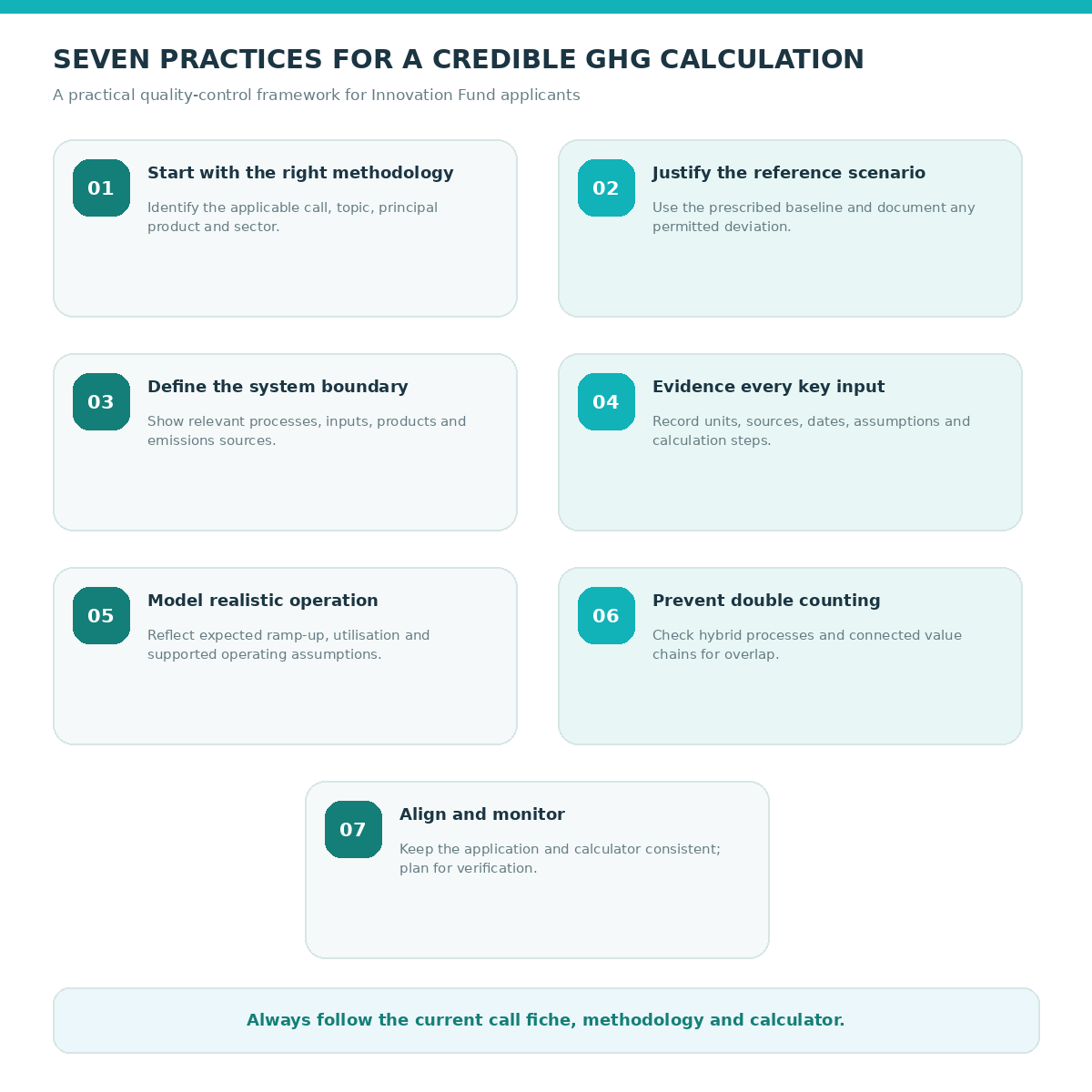
The most useful quality-control steps can be summarised as follows:
- Start with the current call text, applicable methodology and required calculator.
- Identify the principal product and justify the reference scenario.
- Define the system boundary and show relevant process flows.
- Trace material inputs to a source, unit, reference period and rationale.
- Reflect realistic operating performance, including ramp-up where relevant.
- Check for double counting and reconcile the calculator with the application form and financial model.
- Design monitoring and reporting around the parameters that underpin the claimed avoidance.
How Impact Funding Europe can support your application
A robust GHG calculation requires coordination between the technical design, environmental assumptions, production forecasts and funding application. The numbers should be traceable to supporting evidence and consistent with the broader project case.
Impact Funding Europe supports companies preparing applications for European funding programmes, including the Innovation Fund. Depending on the agreed scope, support can include structuring the funding case, coordinating technical inputs, reviewing consistency across application documents and identifying gaps that need to be addressed by the project team or specialist partners.
For projects with complex industrial processes, hybrid technologies, carbon capture or multi-sector boundaries, clarify early which technical specialists will validate the underlying data and which team members are responsible for the official calculator and supporting documentation.
Preparing an Innovation Fund application? Contact Impact Funding Europe to discuss your project and the requirements that need to be addressed before submission.
Preparing an Innovation Fund application?
Official sources and methodology note
This article is based primarily on the European Commission’s 2026 evaluation of the Innovation Fund’s operation. Technical rules must be checked against the current methodology, calculator and call documents for the specific application. The ECA findings cited below are audit observations about the framework and examples it examined; they should not be treated as permission to depart from the applicable methodology.
- European Commission: Evaluation of the Innovation Fund’s operation, SWD(2026) 199 final (published 17 July 2026)
- CINEA: Innovation Fund – Tools and Guidance
- European Court of Auditors: Special Report 11/2026 (published March 2026)
- EUR-Lex: Commission Delegated Regulation (EU) 2019/856, Article 8 – Special recovery rules
Frequently asked questions
Is GHG emissions avoidance the only Innovation Fund award criterion?
No. For regular grant calls it is assessed alongside other criteria, including innovation, project maturity, cost efficiency and replicability. The applicable call document determines the exact criteria, scoring and thresholds.
Can I use the same GHG calculator and threshold as a previous call?
Not without checking. Methodology versions and requirements may differ by call and topic. Use the documents and calculator identified for the application you are preparing.
What happens if verified emissions avoidance is below 75% of planned avoidance?
Article 8 of Delegated Regulation (EU) 2019/856 provides for proportional recovery or reduction of relevant support paid or payable after financial close if total verified avoidance over the reporting period falls below 75% of the planned total, subject to the regulation’s provisions and exceptions. The grant agreement specifies the contractual procedures.
Can a separate LCA replace the Innovation Fund calculator?
Do not treat a separate LCA as a substitute for the calculation required by the call. Use the official methodology and calculator; supporting LCA work may provide evidence for inputs where it is relevant and permitted by the applicable rules.
This article is based primarily on the European Commission’s 2026 evaluation of the Innovation Fund’s operation. Technical rules must be checked against the current methodology, calculator and call documents for the specific application. The ECA findings cited are audit observations about the framework and examples examined; they should not be treated as permission to depart from the applicable methodology. This article is provided for general information only and does not constitute legal advice or a funding guarantee.