
By Yasir Khan · Published 26 October 2026
A practical guide for companies developing innovative low-carbon projects in Europe
The EU Innovation Fund supports the demonstration and deployment of innovative low-carbon technologies that can help decarbonise European industry. But a promising technology alone is not enough to secure support. Applicants need to demonstrate meaningful innovation, credible emissions reductions, convincing project maturity and a realistic pathway to implementation.
The European Commission’s 2026 evaluation of the Fund’s operation offers an evidence-based view of how the programme has performed and where applicants continue to face challenges. Its portfolio data largely cover the period up to the first quarter of 2025, so the figures below should be read as a snapshot of the Fund’s early implementation – not as a statement of current call status.
| Programme funding | The Innovation Fund is financed by EU ETS allowance revenues; the ECA describes an estimated envelope of around €40 billion for 2020–2030. |
|---|---|
| Portfolio at end March 2025 | 208 projects had been awarded grants; 192 remained ongoing, with €11.6 billion in committed support. |
| Expected climate impact | The 192 ongoing projects were expected to avoid 871 million tonnes of CO₂-equivalent emissions over their first decade of operation. |
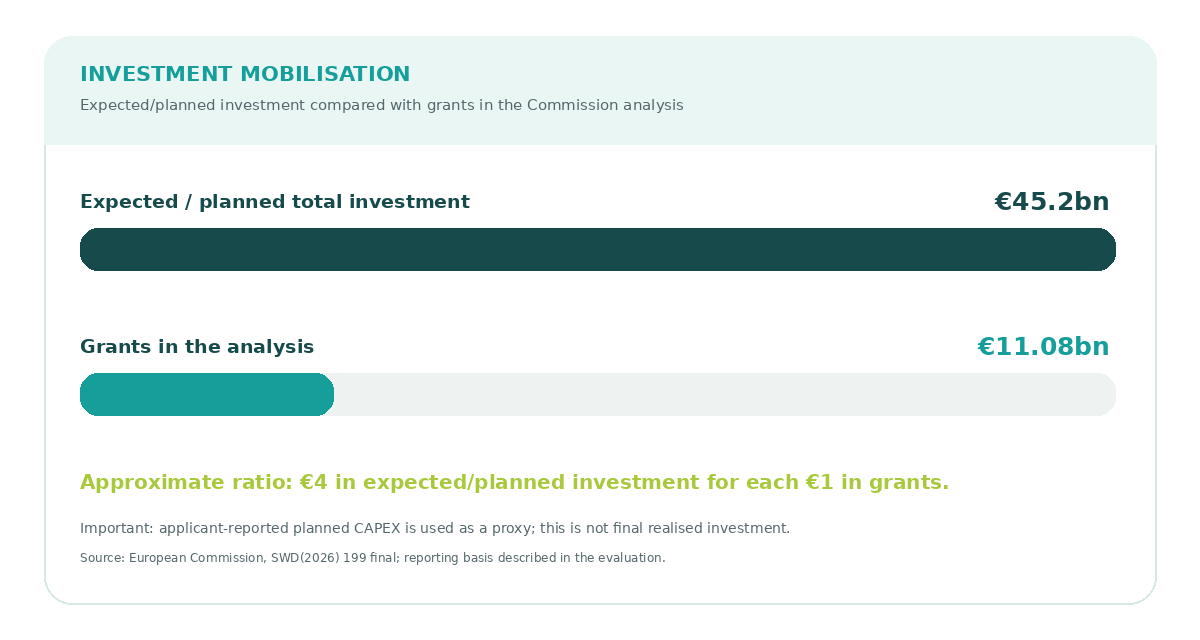
| Investment mobilisation | The Commission’s analysis reported €45.2 billion in expected/planned total investment against €11.08 billion in grants; planned CAPEX was used as a proxy. |
Source reports: European Commission evaluation (SWD(2026) 199 final) | European Court of Auditors Special Report 11/2026
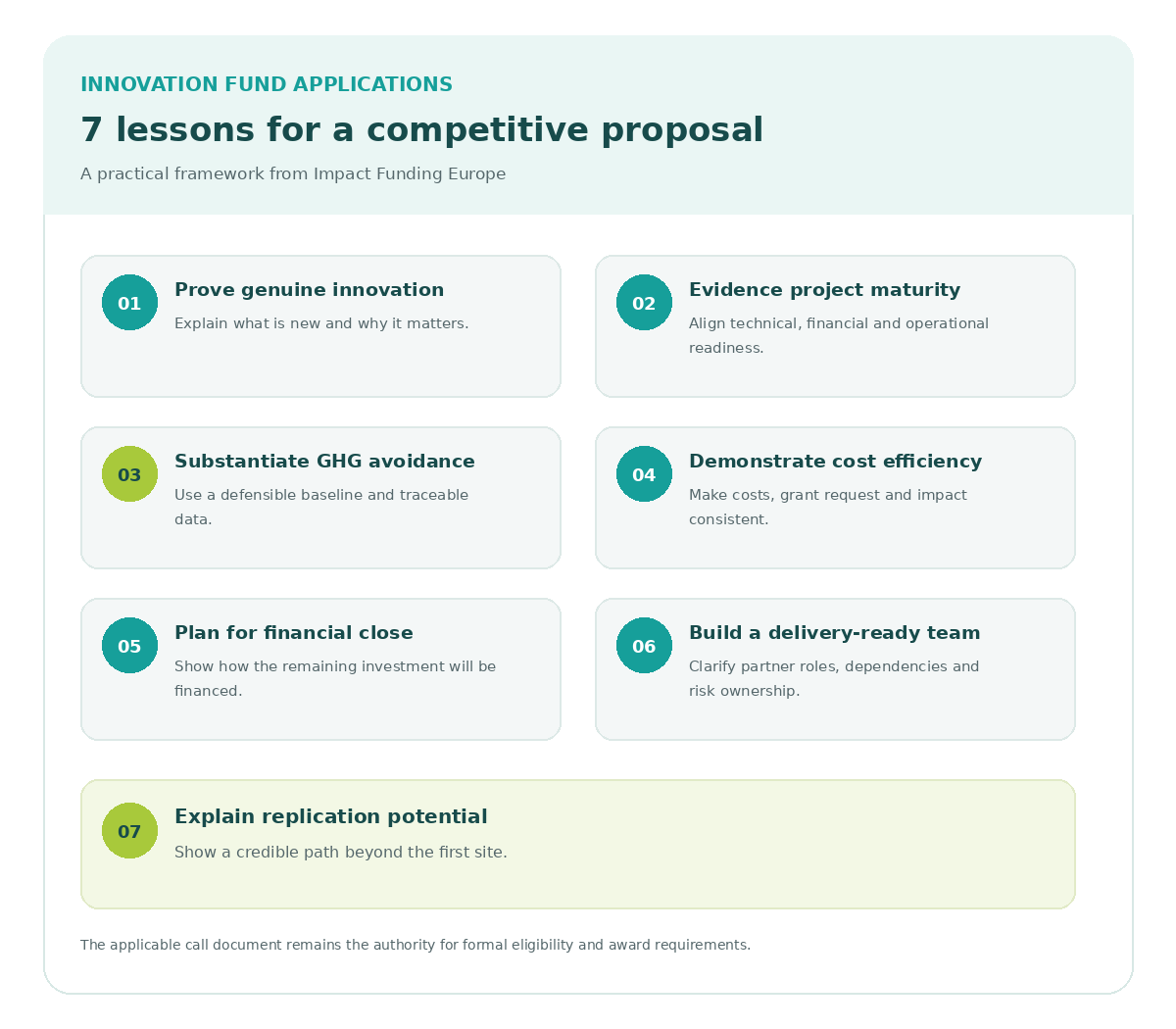
For organisations preparing an Innovation Fund application, the report points to seven practical lessons.
1. Demonstrate genuine innovation – and explain the role of public support
The Innovation Fund is not a general decarbonisation grant. It is designed to support innovative technologies, processes, products and solutions with significant potential to reduce greenhouse gas emissions. The evaluation identifies the degree of innovation as a core element of the regular-grant assessment and notes that projects similar to previously funded solutions must explain what is new about their own proposal.
Applicants should establish a clear baseline against which their technology can be assessed. Explain what is technically or commercially new, how the proposed solution differs from the current state of the art, and why the innovation matters for the relevant industrial process or market.
The funding rationale should also be credible. Although “additionality” should not be presented as a standalone award criterion unless the applicable call says so, the project narrative and financial plan should clearly explain the funding need, the investment barriers and the role Innovation Fund support is expected to play in enabling or accelerating deployment.
Where comparable technologies have already received support, avoid relying on broad claims such as “first of its kind” or “revolutionary” without evidence. Identify the specific differentiators – such as scale, application, performance, process integration or deployment conditions – and substantiate them.
IFE insight
A clear innovation case moves beyond describing the technology. It explains what changes compared with existing solutions, why that change matters and how the project supports credible industrial decarbonisation.
2. Match project maturity to the right call
The Commission evaluates project maturity across technical, financial and operational dimensions. Technical maturity concerns the feasibility of the expected outputs, knowledge of technical risks and proposed mitigation measures. Financial maturity concerns the credibility of the business model and financing plan, including the ability to reach financial close within the applicable timeframe. Operational maturity looks at the implementation plan, the project team and the status of permits, licences and regulatory procedures.
These dimensions must reinforce one another. A technically promising project can still appear unready if critical permits are missing, the delivery schedule is unrealistic or the financing plan relies on unsupported assumptions. Applicants should assemble evidence proportionate to the project and the chosen call, including engineering studies, risk registers, implementation schedules, financing plans and a realistic account of outstanding approvals.
Call choice matters, too. Project size, technology area, readiness and the specific topic all affect which call or funding route is appropriate. Do not assume that a project eligible for one Innovation Fund call will automatically fit another. Review the current call fiche and its definitions, eligibility rules, award criteria, cost methodology and submission requirements before building the application around them.
The Commission also found that tailored Project Development Assistance (PDA) has helped some initially unsuccessful proposals address maturity gaps. By 2024, 16 of the 37 PDA beneficiaries who reapplied had secured an Innovation Fund grant – a 43% success rate among those reapplicants. This is not a general success-rate forecast: PDA recipients were selected from among promising proposals, and the Commission cautions against treating the result as a causal comparison.
Practical check
Can the project team show where the project stands today, what remains to be completed, who owns each action and how the remaining work fits the grant and financial-close timetable?
3. Build a greenhouse gas calculation that stands up to scrutiny
Greenhouse gas (GHG) emissions avoidance is central to the Innovation Fund. A weak calculation can undermine the credibility of an otherwise promising project. The Commission’s evaluation highlights three aspects of the assessment: absolute emissions avoidance, relative emissions avoidance and the quality of the calculation.
Applicants should identify and justify the reference scenario, define the relevant system boundaries and use traceable, defensible data. Assumptions about production volumes, energy consumption, feedstock use, emissions intensity and operating performance should be aligned with the technical design and financial model, where relevant. Any material uncertainty should be treated transparently rather than hidden inside optimistic assumptions.
A large headline figure for tonnes of CO₂ avoided is not sufficient by itself. Evaluators need to understand how the result was calculated and why the baseline is appropriate. GHG calculations should therefore be developed in parallel with the technical and financial case – not treated as a formality to finish at the end of the application.
The legal framework also links part of the grant support paid after financial close to verified emissions avoidance during the reporting period. Under Article 8 of Delegated Regulation (EU) 2019/856, where total verified emissions avoidance over that period is below 75% of the planned total, the relevant amount paid or payable after financial close is proportionally reduced or recovered, subject to the regulation’s provisions and exceptions. Exact obligations should be checked against the regulation and the project’s grant agreement.
IFE insight
An emissions calculation should be traceable from source data to final result. Align the reference scenario, technical assumptions and financial model, and verify all call-specific methodological requirements before submission.
4. Demonstrate cost efficiency and value for money
The regular-grant assessment considers cost efficiency in relation to the grant requested and the project’s absolute GHG emissions avoidance. Applicants should make sure that the requested support, eligible or relevant costs, emissions calculations and financial assumptions are consistent with the methodology set out in the call.
A strong financial case needs more than a large project budget or a high emissions-reduction claim. It should use credible cost estimates, clearly explain the assumptions and show how the requested support relates to the project’s expected climate benefits. Errors or incomplete calculations can weaken an application even when the technology is attractive.
For most topics, the Commission’s evaluation says cost-efficiency ratios above €200 per tonne of CO₂-equivalent lead to rejection, but thresholds differ for some topics, including pilots. Treat this as call-specific: check the relevant call fiche and scoring formula, especially where future call terms have not yet been published.
Similarly, regular Innovation Fund grants can cover up to 60% of relevant costs under the applicable methodology and conditions. This is not a promise to cover 60% of every project’s total capital expenditure. Applicants need a clear view of which costs are relevant and eligible, what the grant can cover and how the remaining investment will be financed.
The Commission’s investment-mobilisation analysis reported around €45.2 billion in total expected or planned investment against €11.08 billion in grants, a ratio of roughly four to one. This was based on applicant-reported planned capital expenditure as a proxy. It should not be represented as a final audited measure of investment realised by all projects.
Preparing an Innovation Fund application and want a second pair of eyes?
5. Plan for financial close from day one
Winning a grant is not the same as delivering a project. The Commission’s evaluation identifies financing gaps and changing market conditions among the principal causes of project delays and withdrawals. Difficulties raising capital, cost increases and an inability to secure offtake agreements can all affect project viability.
Applicants should develop a financing strategy that goes beyond the amount requested from the Innovation Fund. It should explain the total investment required, the expected grant contribution, other sources of finance, the status of financing discussions and the assumptions that underpin projected revenues and operating costs. Any material dependencies should be identified clearly.
Financial close also depends on delivery readiness. The project plan should identify the permits, licences, construction arrangements, partner commitments and commercial agreements that remain outstanding, together with realistic timelines and mitigation measures. For projects that rely on future infrastructure – such as grid connections, hydrogen pipelines or CO₂ transport and storage – explain the dependency and the status of the relevant arrangements.
The European Court of Auditors’ 2026 audit provides a separate warning about implementation risk. It found that, by 30 June 2025, 40 of 228 projects initially selected for support had been cancelled or withdrawn: 20 before grant agreements were signed and 20 after signature. This is a different measure from the Commission evaluation’s count of terminated signed projects. It nevertheless reinforces the importance of realistic maturity assessments and financing plans.
Practical check
For every major financing, permitting, infrastructure or offtake dependency, record its current status, the accountable party, the expected completion date and the consequence if it is delayed.
6. Show that the delivery team and value chain can execute the project
Project maturity is not only a matter of technology and spreadsheets. It also depends on whether the organisation or partnership responsible for delivery has the capabilities, governance and commitments needed to bring the project into operation.
Where a project relies on multiple partners, the application should make the division of responsibilities clear. Technical providers, industrial hosts, engineering and construction partners, feedstock or energy suppliers, offtakers, infrastructure operators and financing partners may all be important, depending on the project. Their roles should be credible and reflected in the implementation schedule and risk plan.
A consortium is not a formal requirement for every Innovation Fund project. The principle is to demonstrate that the proposed delivery structure is appropriate to the project’s complexity and that essential capabilities are covered. Unclear responsibilities, dependence on a single key partner or assumptions about unconfirmed commercial relationships can create avoidable weaknesses.
The project should also explain how it fits into the wider value chain. For industrial decarbonisation, this may include access to reliable low-carbon energy, transport and storage infrastructure, sustainable inputs, customers for the resulting product and the relevant permitting framework. These elements help connect the proposal’s technical ambition to its real-world implementation conditions.
7. Explain how the project can be replicated and scaled
The Innovation Fund is designed to support projects with the potential to contribute to broader decarbonisation, not just deliver a single successful installation. Replicability is therefore a core part of the regular-grant assessment.
A strong proposal should explain where and how the technology could be deployed beyond the first site, what future efficiency or environmental gains may be possible, and which conditions would enable replication. Depending on the project, these might include standardised equipment, lessons from demonstration, cost reductions, compatible infrastructure, transferable operating practices or the development of a stronger European supply chain.
The case should remain realistic. Distinguish what the initial project will demonstrate from what might be achieved at additional sites or at larger scale. Set out assumptions, prerequisites and potential barriers. Avoid unsupported claims about the number of future installations, market share or emissions savings that the project itself will not directly deliver.
The Commission’s evaluation reports that the 192 ongoing projects were expected to avoid 871 million tonnes of CO₂-equivalent emissions over their first decade of operation. This is a portfolio-level projection, not a realised emissions outcome, and it does not automatically measure the wider replication impact of each project. The role of an applicant is to present a credible project-specific case for how its innovation can support wider deployment.
What these lessons mean for prospective applicants
The Commission’s evaluation shows that a competitive Innovation Fund application requires consistency across the technical, environmental, financial and operational case. The technology must be genuinely innovative, the emissions calculation must be defensible, the cost-efficiency case must follow the applicable methodology, and the financing and implementation plan must stand up to scrutiny.
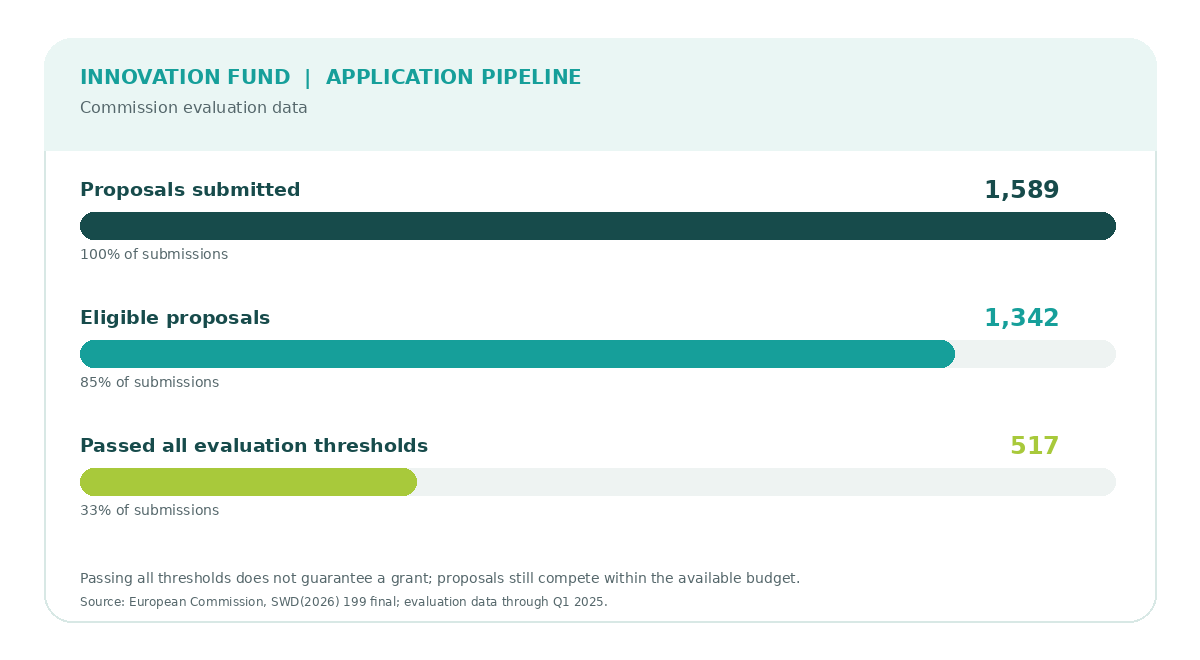
The evaluation’s proposal data also underline the competitive nature of the programme. Across the proposals covered by its summary, 1,589 were submitted, 1,342 were eligible and 517 passed all evaluation thresholds. Passing thresholds does not necessarily guarantee funding: proposals also compete within the available budget, and high-quality proposals can remain unfunded when demand exceeds resources.
A practical preparation process should therefore begin well before submission. Confirm the right call, test the project’s maturity, align the technical and financial models, verify the GHG methodology and identify the evidence needed to support every significant claim. The current call documentation remains the controlling source for eligibility, scoring and submission requirements.
Looking ahead: IF26 calls (time-sensitive)
As of 15 October 2026, the European Commission’s calls page states that five IF26 calls are planned to open in December 2026: Net-Zero Technologies, SME, Maritime, Heat Auction and Hydrogen Auction. The planned SME call has a €200 million budget and is intended for SME projects with €2.5 million–€20 million in capital expenditure, with two application rounds indicated. Dates and conditions are indicative until confirmed in the published call documents. Check the live Commission pages before relying on these details.
How Impact Funding Europe can support your Innovation Fund application
Preparing an Innovation Fund application requires technical, environmental, financial and commercial information to support one coherent case for funding. Impact Funding Europe provides EU grant-writing and funding support for organisations developing smart, digital and climate-neutral projects, including proposal writing, consortium building, fund matching and project administration.
For a prospective applicant, an early discussion can help identify the relevant funding route, clarify the work needed to prepare a competitive proposal and surface gaps in the project’s technical, financial or operational case.
Considering an Innovation Fund application?
Contact Impact Funding Europe to discuss your project and the appropriate next steps.
Official sources
- European Commission (2026), Evaluation of the Innovation Fund’s operation, SWD(2026) 199 final
- European Court of Auditors (2026), Special Report 11/2026: Innovation Fund
- Commission Delegated Regulation (EU) 2019/856 – Article 8 recovery rules
- European Commission, live Innovation Fund calls page
- European Commission, IF26 SME Call page
- European Commission, IF25 Net-Zero Technologies Call fiche (illustrates call-specific thresholds)
This article reflects the European Commission’s 2026 evaluation of the Innovation Fund’s operation and portfolio data up to the first quarter of 2025. Figures are a snapshot of the Fund’s early implementation and not a statement of current call status. Call dates and conditions are indicative until confirmed in the published call documents; check the live Commission pages before relying on these details.